

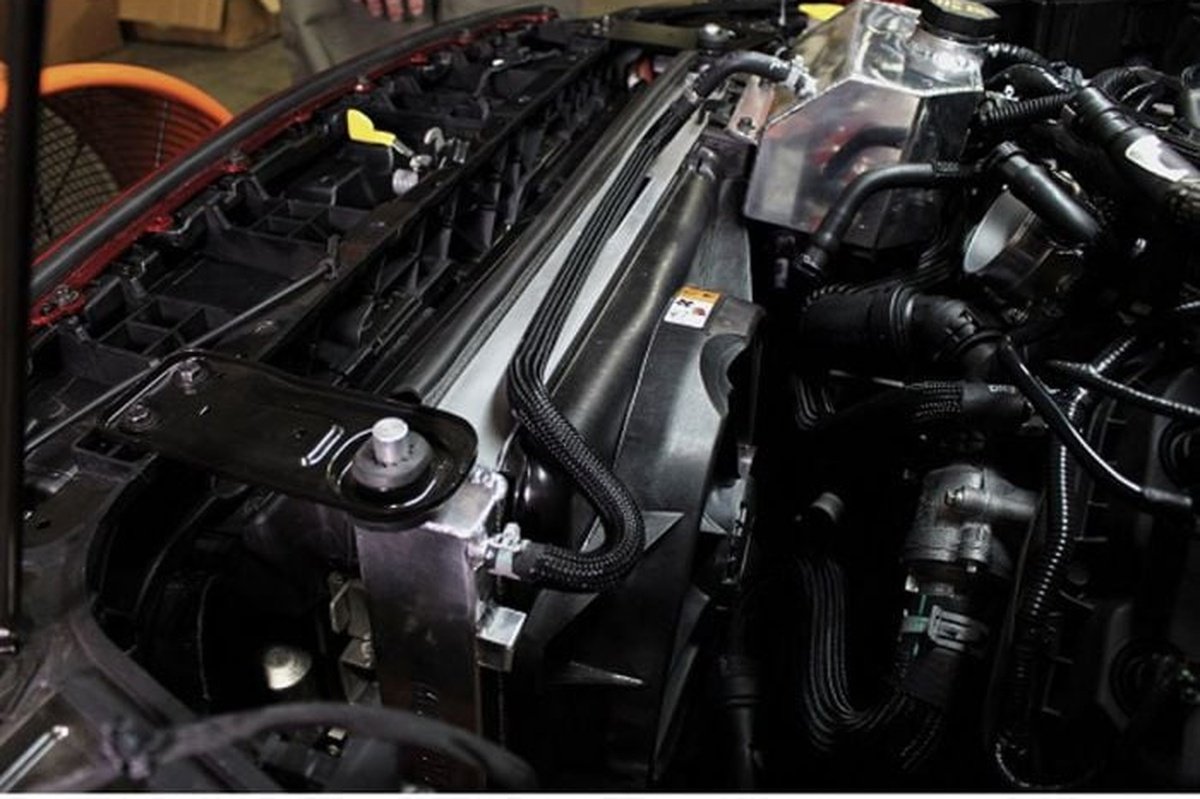
Cover: Mishimoto radiator shown in the supplier’s Mustang engine-bay installation photograph. Photo: CJ Pony Parts. Exact radiator and transmission fitment vary by application.
A Mustang radiator upgrade should answer a diagnosed cooling need and fit the engine, transmission and airflow package actually installed. Aluminum construction, a thicker core or more rows does not by itself establish a lower operating temperature. The radiator works with the fan, shroud, thermostat, pump, coolant and the rest of the system.
This guide compares four pictured Mishimoto radiators from a classic 289 manual to an S550 GT, with application boundaries for each. It focuses on buying the right component and planning the job. It does not prescribe one coolant, pressure cap or bleeding procedure for every Mustang built over six decades.
Affiliate disclosure: Ultimate Stangs may earn a commission through shopping links at no extra cost to you. This research-based guide compares documented specifications and applications. We have not independently tested these products or assigned consumer-vote scores.
| Observed issue | Questions to resolve first |
|---|---|
| Temperature rises at idle | Fan operation, shroud, airflow and the exact diagnostic procedure |
| Leak or loss of coolant | Locate the fault; inspect connections and surrounding components |
| Track or repeated high-load use | Document the complete cooling package and actual conditions |
| Engine / transmission swap | Hose routing, mounts, transmission cooling and current hardware |
| Age-related replacement | Condition of hoses, seals, mounts and the rest of the system |
Diagnose before buying a larger core
A cooling complaint does not identify a failed radiator on its own. A fan that is not operating correctly, air bypassing a poorly sealed core or a problem elsewhere in the system can remain after a new radiator is installed. Record when the symptom occurs and have the system assessed using the instructions for the exact car.
An older Mustang adds another layer: its current engine, fan arrangement and radiator support may differ from the original build. The replacement has to fit what is there now. A shiny aluminum assembly does not resolve an incorrectly routed hose, deteriorated mount or incomplete conversion.
Use operating-temperature evidence from your own properly diagnosed car rather than a supplier capacity percentage as the starting point. We have not measured before-and-after temperatures for these products. A published increase in coolant volume describes volume; it does not establish the same percentage improvement in heat rejection or a guaranteed result in traffic.
Aluminum, rows and airflow
A radiator transfers heat through a core supplied with coolant and exposed to airflow. Tube and fin design, core dimensions and the way air is directed through the assembly matter alongside material and row count. Comparing “two-row” with “three-row” across different generations is therefore not a complete performance ranking.
Mishimoto’s separate 2024-and-newer Mustang radiator listing, for example, describes a one-row core for its own application. That does not make it inherently inferior to an older three-row design. It illustrates why the actual design and installation context matter more than choosing the largest row number on a search page.
Space matters too. Check the relationship among radiator, fan assembly, shroud, condenser and nearby components. Retain the sealing and mounting arrangement specified for the car and part. A thicker component should be evaluated as an installed assembly, not simply compared by its appearance in a standalone product photograph.
Match the transmission and generation
| Mustang years | Featured scope / next check |
|---|---|
| 1965–1966 | 289 V8 manual; no integrated automatic cooler in the featured part |
| 1967–1978 | Use a separately documented engine / transmission application |
| 1979–1993 | Seller’s manual-transmission radiator; inspect swaps and hose routing |
| 1994–2004 | Separate SN95 / New Edge part and engine application needed |
| 2005–2014 | Featured V6 / GT manual; do not assume GT500 or automatic fitment |
| 2015–2023 | Featured S550 GT manual / automatic listing |
| 2024–2026 | Separate S650 radiator family; no carryover assumption |
Transmission cooling is a purchase requirement, not an afterthought. Some featured manual applications lack an integrated automatic cooler, and the S197 seller describes separate cooling hardware for automatic use. That does not establish a complete conversion plan. Have the supplier or installer document the correct cooling arrangement for the actual transmission.
Pressure and coolant specifications are just as application-dependent. A cap supplied in a box identifies what is included, but an old or modified system still needs the correct pressure compatibility checked. Follow the Ford manual and the exact part instructions for coolant specification, filling and bleeding. Never open a hot pressurized cooling system.
Four radiators to compare
1965–1966 289 manual: check the whole cooling system
Mishimoto MMRAD-MUS-64 is the classic manual-transmission option in this selection. The seller describes a two-row aluminum assembly with TIG-welded tanks, a magnetic drain and a supplied 1.3-bar cap. Those specifications help identify the product, but an old car’s current radiator support, hoses and pressure-rated components still need inspection before treating it as a straightforward replacement.
There is no integrated automatic-transmission cooler in this featured application. Do not assume that adding a generic external cooler creates a complete automatic conversion plan. Check the exact engine, transmission and hose arrangement with the supplier. The live page estimates dispatch in three weeks, which conflicts with the feed’s in-stock flag; confirm availability before dismantling the car or scheduling the work.
1979–1993 manual: restore the airflow path too
The MMRAD-MUS-79 addresses the Fox-era manual-transmission application with a two-row brazed-aluminum core and stamped aluminum end tanks. The supplied cap and magnetic drain are useful service details. Compare the actual engine and hose positions on a modified Fox rather than assuming that the original model year establishes the current cooling layout.
This is also a good point to inspect the surrounding airflow hardware. A replacement core cannot do the work of a missing shroud, an incorrectly functioning fan or air that bypasses the radiator through an unsealed gap. Build a quote around the complete system, including the condition of mounts and hoses. The accompanying supplier video is an installation reference for its demonstrated configuration, not evidence of a measured temperature improvement on your car.
2005–2014 V6/GT manual: compare installation space
Mishimoto MMRAD-MUS-05 is the featured S197 manual-transmission choice, listed for 2005–2014 V6 and GT applications. Its three-row construction and TIG-welded aluminum tanks distinguish the physical product, while the specified 1.5-inch connections make hose compatibility a concrete check. More rows alone do not establish better cooling in every installation.
Ask how the core, fan assembly, shroud and neighboring components fit together on the actual engine and year. The supplier discusses a separate transmission-cooling requirement for automatic use; this guide does not turn that into a universal automatic fitment recommendation. A GT500 or swapped car needs its own documented application. Compare the complete installation requirements before choosing on appearance or row count.
2015–2023 GT: distinguish S550 from S650
The MMRAD-MUS8-15 listing gives S550 GT owners a three-row, 52 mm radiator with mounting hardware, an installed rubber trim seal and magnetic drain. The seal and mounting details matter because a cooling component has to integrate with the car’s airflow path and adjacent assemblies. This selection features the documented 2015–2023 GT manual and automatic applications.
Do not carry this part number forward just because a 2024-and-newer GT also has a 5.0-liter V8. Mishimoto lists a separate S650 radiator family. Likewise, do not convert the retailer’s broad Shelby wording into a claim that a GT350 had a factory automatic. We have not tested the advertised capacity changes or measured coolant temperatures; added volume and a thicker core are specifications, not an independent performance result.
Watch the matching installation context
Video: CJ Pony Parts. Archival supplier demonstration for the documented Fox manual application. The car’s fan, shroud and connections must match the actual installation.
Video: CJ Pony Parts. Supplier reference for the S550 GT product. It is not a procedure or fitment approval for an S650, GT500 or swapped car.
Price the entire cooling job
Ask for a quote that identifies the radiator, required coolant and service work, and any hoses, seals or mounts that need replacement. Keep those findings distinct from optional upgrades. Replacing sound components solely because they appear near the radiator is a different decision from repairing a documented problem.
Check delivery before the car is taken apart. The classic radiator’s current three-week estimate is relevant to a project schedule, even though the product feed calls it in stock. A supplier’s dispatch estimate can change, and it is not the same as a guaranteed arrival date at the installer.
After installation, use the manufacturer’s checking procedure and compare operation under the relevant conditions. Do not assume that a different temperature-gauge position automatically establishes a quantified performance gain. For a road-and-event build, the wider suspension guide and budget performance guide can help separate cooling reliability, chassis priorities and engine-output claims in the overall plan.
Questions answered
Will an aluminum radiator add horsepower?
This guide establishes no horsepower gain. The products concern the cooling system; material and coolant capacity are not independent engine-output results.
Is a three-row radiator always better?
No universal ranking follows from row count alone. Compare the actual core design, airflow, installation space and documented application.
Can a manual radiator be used with an automatic?
Do not assume so. Verify the exact transmission-cooling requirement and a complete documented installation, rather than treating a generic external cooler as automatic approval.
Does the S550 GT radiator fit a 2024 GT?
The featured MMRAD-MUS8-15 is the 2015–2023 GT application. A 2024-and-newer S650 requires its own documented part.
Can I use the supplied cap on any modified classic?
Confirm pressure compatibility across the actual system and follow the exact instructions. A supplied 1.3-bar cap is a contents specification, not universal approval for every old hose, heater core or conversion.
Sources and selection method
Exact supplier application panels, package specifications, current dispatch notes, authorized photographs and joined-affiliate links checked November 20, 2026. The four CJ Pony Parts listings and linked Mishimoto S650 reference establish the stated boundaries. Supplier videos are application-specific context. No independent coolant-temperature, pressure, heat-rejection or power test was performed.

