

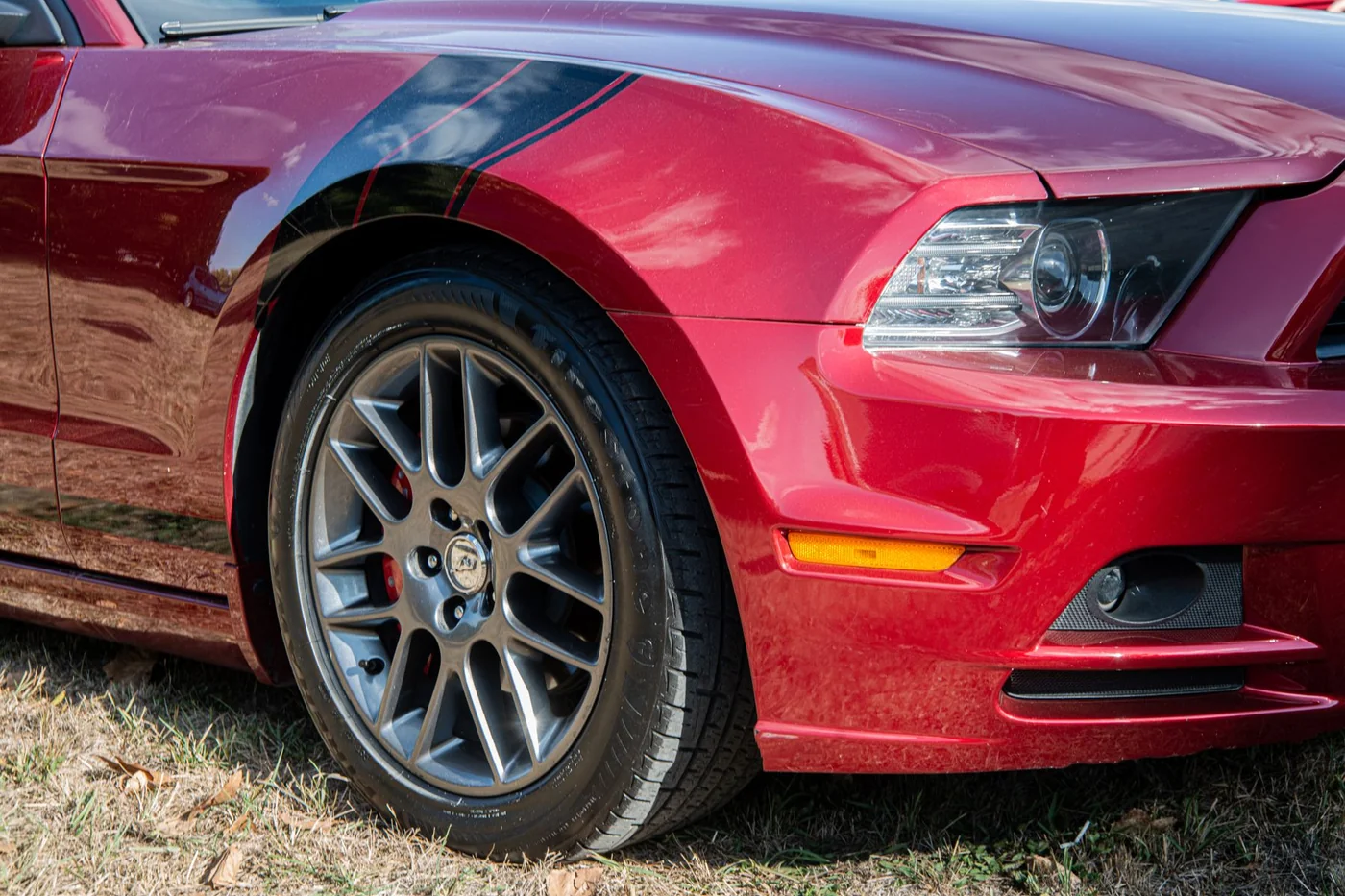
A low-pressure warning on a cool morning can turn a simple Mustang drive into a guessing game. Is the dashboard wrong? Should you add air to the number on the sidewall? Does a wider rear tire need a different target? Start with the car’s own information, then measure what is actually in each tire.
Quick answer: Use the recommended cold inflation pressure for your exact Mustang and tire setup. For an original-equipment setup, find the Tire and Loading Information label near the driver’s door. There is no single PSI that applies to every Mustang generation, trim, wheel package, and replacement tire.
Advertising disclosure: Display advertisements on this page contain affiliate links; Ultimate Stangs may earn a commission from purchases through them. Use your vehicle’s specifications when selecting replacement tires or equipment.
Where to find the right Mustang tire pressure
Open the driver’s door and look for the tire-information label. Read the front and rear entries separately, check the listed tire sizes, and note whether a spare has its own requirement. If the label is missing, unreadable, or does not match your current wheels and tires, resolve that mismatch before relying on a number.
NHTSA’s TireWise guidance identifies the vehicle label and owner’s manual as the starting points for recommended inflation pressure. The maximum on the tire sidewall is not the car’s target pressure. A different Mustang in a forum photo is not a substitute for your label, either.
Make a phone note or take a clear picture of your label. Record the target beside each axle rather than writing one large number that could be mistaken for all four corners. That small habit is useful when a service shop, a family member, or a roadside technician adds air later.
| Information you find | How to use it |
|---|---|
| Vehicle tire-information label | Starting point for the original tire setup; read front and rear entries. |
| Owner’s manual | Vehicle-specific checking, spare-tire, TPMS, and special-use instructions. |
| Maximum molded on the tire | A limit for that tire, not a universal operating target for your Mustang. |
| Replacement-wheel or tire documentation | Have a qualified tire professional confirm the pressure and load suitability of a changed setup. |
| A track or drag-strip recommendation | A separate use case; do not automatically use it for street driving. |
What “cold tires” actually means
Cold describes the tire’s recent use, not whether it feels chilly outside. Michelin’s checking instructions call for a reading before driving or after at least three hours parked. Taking all four readings before the first drive gives you a consistent starting point.
Driving heats tires, so a reading after a highway trip cannot be compared casually with a cold target. Ford’s 2025 Mustang tire-care guidance specifically says not to reduce the pressure of warm tires. If a tire is visibly damaged or seriously low, do not keep driving merely to reach a preferred checking location; arrange appropriate assistance.
Your cold-pressure check, at a glance
Find your targets
Read the vehicle label. Keep front and rear specifications separate.
Measure before driving
Use a gauge on cold tires, not a number guessed from the sidewall.
Adjust and recheck
Compare every reading with the correct target for that axle.
Record all four
Log the date and each corner. Investigate repeated pressure loss.
How to check and adjust pressure, step by step
Have a reliable pressure gauge, access to suitable air, and the correct cold targets ready. Work where you can reach all four valve stems safely. Continental’s pressure-check guide supports a measure, adjust, and recheck routine rather than guessing from appearance.
- Read the label first. Match its axle and tire information to the car in front of you.
- Check the tire’s condition. Look for obvious damage before putting your face or hands close to a suspect tire.
- Remove the valve cap and seat the gauge squarely. If it hisses continuously, reposition it and take another reading. Do not force a seized cap.
- Write down the reading. Keep front-left, front-right, rear-left, and rear-right separate.
- Adjust in small amounts and remeasure. For a cold tire, work toward its correct target without exceeding applicable limits.
- Repeat at every corner and check the spare if equipped. Use the spare’s own specification, then replace the valve caps.
If the gauge and an air-pump display disagree substantially, do not average the numbers and hope. Check the equipment or ask a tire shop to verify the reading. A pressure log is only useful when the measurement is reasonably trustworthy.
Watch the gauge connection—not the example pressure
Why a tire-pressure warning can appear on a cold morning
A temperature change can lower the pressure enough to trigger a warning that was absent the day before. Continental describes an approximate change of one PSI for a 10°F temperature change. That is an explanation for the pattern, not permission to add a fixed extra amount to every tire.
Take a cold gauge reading and compare it with the proper target. If one tire repeatedly loses pressure while the others remain stable, have it inspected rather than treating every alert as weather. Keep the dates, readings, and conditions in your notes so the shop has something more useful than “it seems low sometimes.”
A solid TPMS light and a flashing light mean different things
A tire pressure monitoring system helps identify a problem; it does not remove the need for a gauge. Schrader’s TPMS guidance distinguishes a solid low-pressure warning from a flashing-then-solid malfunction indication. Check the exact meanings and instructions in your Mustang’s manual.
| What you notice | What to do next |
|---|---|
| Low-pressure warning stays on | Inspect the tires and measure their pressures promptly; correct the cause, not just the lamp. |
| Lamp flashes, then remains on | Treat it as a possible monitoring-system fault and arrange diagnosis. You still need to check actual pressure. |
| Light disappears as the day warms | Take cold readings; a temporarily quiet warning does not prove the pressures were correct. |
| Warning after a wheel or tire change | Ask the installer to verify sensor compatibility and the model-specific learning procedure. |
| Repeated pressure loss at one corner | Have the tire, valve, and wheel inspected; repeated topping-up is not a diagnosis. |
Do not use a generic ignition-key sequence to “reset” every Mustang. Model years and equipment differ, and a system may need the proper drive cycle, sensor training, or fault diagnosis. Inflating a tire cannot repair an incompatible or failed sensor. Older or modified cars also deserve an equipment check before assuming that a factory warning system is present and functional.
Which warning are you seeing?
Solid low-pressure light → inspect and measure
Check the tires and take gauge readings promptly. Use the correct cold specifications to resolve low pressure. A visibly damaged or seriously low tire needs appropriate assistance, not more driving to clear a light.
Flashing, then solid → investigate the system too
Consult your model’s manual and arrange diagnosis of a possible TPMS fault. Check actual tire pressure as well; sensor troubleshooting does not establish that the tires are properly inflated.
Older and modified Mustangs may have different equipment. This guide does not replace the instructions for your particular car.
Staggered tires, aftermarket wheels, and seasonal sets
A staggered setup means the front and rear tires are different sizes. That makes reading axle-specific information especially important, but it does not, by itself, tell you what either pressure should be. Wider does not automatically mean “add more air” or “run less air.”
If the installed tires differ from the label, ask a qualified tire professional to confirm load capacity and the correct inflation recommendation for that combination. Bring the tire sizes, load ratings, wheel specifications, and vehicle information. Do not copy a target from a different trim simply because its wheels look similar.
For shopping considerations beyond pressure, use our Mustang tire buying guide. For cold-weather storage, check the tire maker’s temperature restrictions and the car’s storage instructions separately. A correct gauge reading does not make a summer tire suitable for winter driving.
Mustang tire pressure FAQs
Should I use the PSI printed on the tire?
Use the vehicle’s recommended cold pressure for the appropriate setup. The sidewall maximum is a limit, not the default target. Changed fitments need confirmation from a qualified tire professional.
How often should I check?
NHTSA recommends checking all tires, including the spare when equipped, at least monthly when cold. Check before a long trip as well, and investigate warning lights or signs of pressure loss promptly.
Can I just rely on the dashboard display?
Use it as a useful warning or reference, then take a proper gauge reading when checking or adjusting the tires. Confirm the display’s operating conditions and update behavior in the owner’s manual.
Will adding air turn the warning off immediately?
Not necessarily. The correct follow-up depends on the vehicle and whether the issue is low pressure or a system fault. Follow the manual; do not keep adding air just to make a light disappear.
Make pressure checks a repeatable habit
Save the correct specification, check cold, and keep all four readings separate. That is more useful than memorizing someone else’s PSI. If a warning returns or your wheel-and-tire combination has changed, use the notes to get a clear answer from the right technician.
Sources and editorial notes
Researched November 12, 2026. This is an original road-use maintenance guide, not a universal pressure chart or a tire test. Sources: NHTSA TireWise, Michelin pressure-check instructions, Continental pressure-check guidance, Ford Mustang tire-care guidance, and Schrader TPMS driver guidance. The original checking diagram and TPMS decision guide summarize the cited instructions. The licensed video is an illustrative gauge demonstration, not a Mustang pressure or fitment recommendation.
Featured photograph: Александр Лич / Pexels. Landscape crop and WebP optimization; illustrative photography, with no endorsement implied.

