

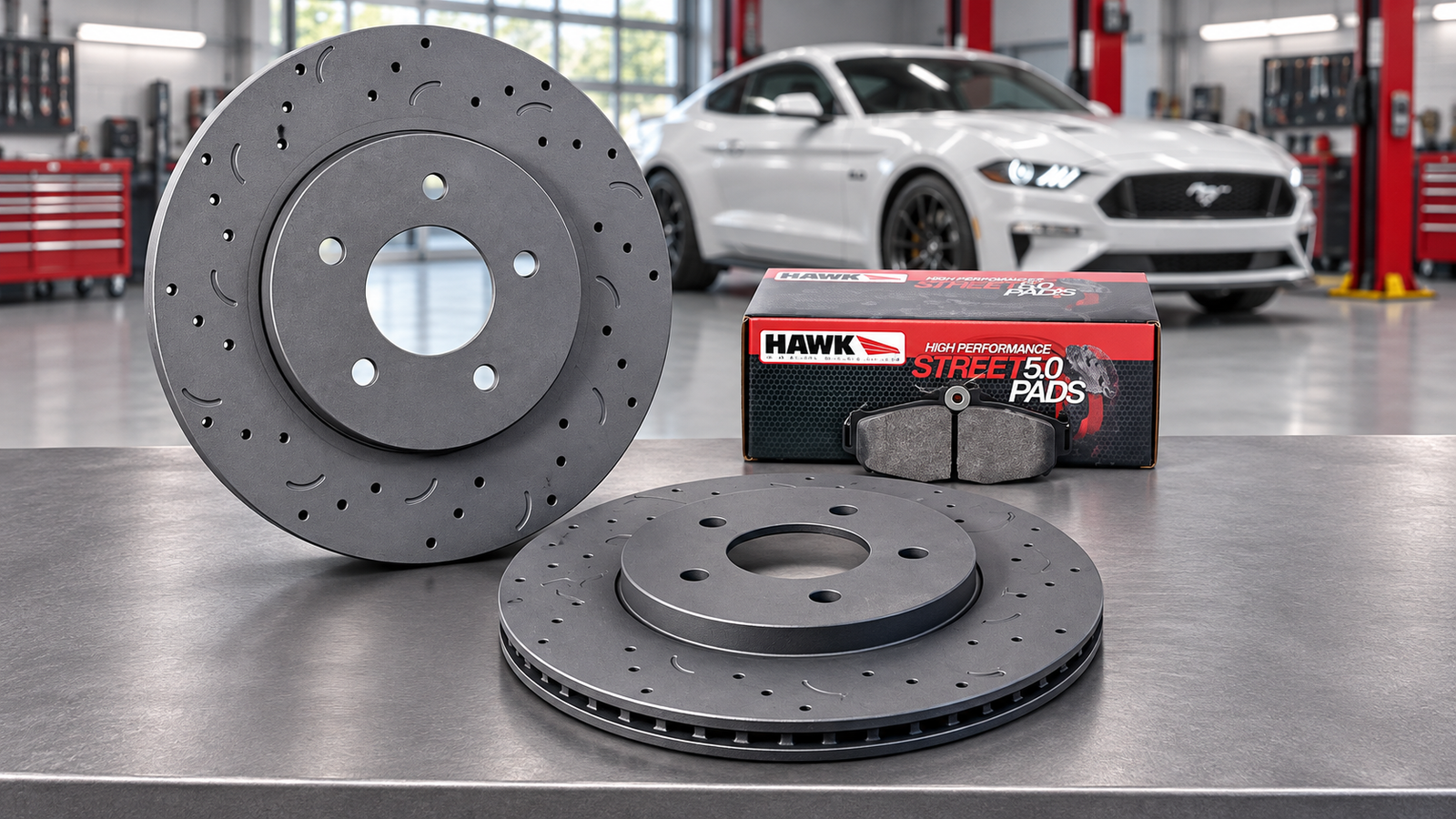
Cover: AI-created editorial styling illustration by Ultimate Stangs, based on the promoted Hawk rear rotor-and-pad package. The background car is illustrative; original supplier photographs appear in the product cards.
Buy Mustang brake pads and rotors for the brake hardware fitted to the car and the way you will use it. Street comfort, low-dust priorities and event use can lead to different compound choices. A more aggressive pad description does not make every component a better match for daily driving.
This guide compares four pictured options: a classic front-disc pad set, an S197 rear rotor-and-pad package, and two S550 GT Performance Pack front compounds with different priorities. It complements our Mustang wheel-cleaning guide and tire buying guide; cleaning, tire grip and brake selection answer different ownership questions.
Affiliate disclosure: Ultimate Stangs may earn a commission through shopping links at no extra cost to you. This is a research-based buying guide. We have not independently tested these products, measured performance gains or ranked them using customer-vote scores.
| Your situation | Useful buying question |
|---|---|
| Routine street service | Which exact pad shape and compound suit the installed calipers? |
| Pads and rotors both need replacement | Is the offer one axle or all four corners, and what does it include? |
| Low-dust street priority | What does the manufacturer design this compound to do? |
| Autocross or track event | What operating conditions, preparation and matching components does the manufacturer specify? |
Identify the actual brake package
Model year and trim start the search, but the installed caliper, rotor and any previous conversion finish it. A classic Mustang can have drums, original-style discs or a conversion with a different pad requirement. A later GT may have a factory performance package, replacement calipers or a larger brake conversion. Photograph the hardware and record its identifiers before ordering.
Ask whether the listing supplies front pads, rear pads, a rotor pair or a larger kit. “A set” does not always mean all four wheels. A rear rotor-and-pad package also does not imply that new calipers, fluid or other service items are in the box. Keeping position and contents beside the product image makes comparisons more useful than sorting by the lowest advertised number.
If a car pulls, develops a warning light, has unusual pedal travel or shows uneven wear, have the cause assessed before choosing a different compound to hide the symptom. A pad purchase is not a diagnosis. This buying guide does not replace the vehicle’s service procedure or a qualified assessment of the system.
Street and event priorities differ
A daily-driven car asks its brakes to behave predictably from ordinary cold starts, in traffic and in changing weather. Noise, dust and the feel of the pedal may influence ownership even when a product is marketed for performance. Choose the manufacturer’s stated use category and exact application instead of treating “ceramic” or “racing” as a complete specification.
Hawk lists HPS, HPS 5.0 and Performance Ceramic within its street compounds. Its separate HP Plus page emphasizes autocross and gives an operating range. That distinction helps frame the two S550 front-pad choices below. It does not establish that a crossover compound is appropriate for unlimited circuit sessions on any Mustang.
For an event, discuss the car’s weight, tires, speeds, session length and expected temperature conditions with the pad supplier and event preparation provider. The matching rear compound, rotor condition, fluid requirements and inspection matter too. A front-pad upgrade alone does not create a complete track-prepared car, and the most important improvement for a particular driver may be preparation rather than a bigger component purchase.
Inspect rotors before replacing them
Choose replacement rotors because the service assessment and the applicable manufacturer requirements support replacement. Do not assume every new pad set needs a new rotor pair, or that a visually attractive drilled pattern fixes an unrelated system problem. Match diameter, thickness specification, mounting and application to the installed hardware.
A documented drilled/slotted design and protective coating describe the chosen product. We have not independently tested those details for stopping distance, heat rejection or durability against an alternative rotor. Compare the complete service scope, including any required cleaning, measuring and bedding procedure, and keep the supplied installation information with the parts.
Four brake purchases to compare
Classic disc brakes: Hawk HPS
This HPS set provides a street-compound option for a classic Mustang with matching front disc-brake hardware. That qualification matters more than the badge: a 1965–1967 car may have original discs, drums or a later conversion, and each arrangement can need a different pad shape. Compare the actual caliper and installed pads with the supplier’s application before choosing the set.
The HB471F.510 identifier and listed 0.510-inch thickness are useful purchasing details; they are more precise than assuming that every classic brake pad is interchangeable. The offer supplies front pads, so it does not include rotors, calipers or a disc-conversion package. Ask the installer to assess rotor condition and the rest of the system separately. CJ lists manufacturer dispatch, which warrants a delivery check before scheduling a service appointment.
S197 rear service: rotors and pads
The Talon/HPS 5.0 package makes sense as a comparison when inspection shows that both rear pads and rear rotors need replacement. It combines a pair of drilled/slotted Talon rotors with the rear pad set, allowing a buyer to compare the price and delivery of a defined axle package. The coating and rotor design are documented construction details, not our own evidence of a shorter stopping distance.
Keep the axle distinction visible in the quote. The selected package does not refresh the front brakes or supply new calipers, and it should not be priced against a four-wheel service without explaining that difference. Ask whether the installed rear hardware still matches the original application and whether the two component types can ship together. The supplier lists additional specific Boss and Shelby applications, but this guide’s featured comparison is the 2005–2014 V6/GT rear arrangement.
S550 street use: Performance Ceramic
For an S550 GT Performance Pack used mainly on the street, the ceramic set is the option to compare when cleanliness and everyday noise matter to you. Hawk positions Performance Ceramic within its street range, and CJ describes a low-dust, low-noise design. Those are product design aims; we have not measured dust accumulation or brake noise on a Mustang to declare it a tested winner.
This is a useful direct comparison with the next pad because the selected application is similar while the compound priorities differ. Confirm the exact Performance Pack front hardware rather than ordering by “GT” alone. The box supplies front pads, not replacement rotors or calipers. If the rest of the system is healthy, a correctly chosen pad service can be a different and more limited job than purchasing a complete brake package.
Autocross use: Hawk HP Plus
HP Plus is the option to investigate when the car’s use moves toward autocross or a defined event requirement. Hawk’s own current product page describes it as ideal for autocross and gives it an operating window; that is a more useful brief than assuming the most aggressive-sounding pad must be best for every road and circuit. Ask the manufacturer which compound suits the car, tire, event length and temperatures you actually expect.
The trade-offs belong in the buying decision. CJ warns that noise, dust, rotor wear and pad life may be affected by the friction level. A front set for this GT Performance Pack application also does not establish a matched rear compound or resolve brake-fluid and rotor preparation. Budget for an appropriate complete system and inspection rather than treating a front pad purchase as an entire track-readiness package.
Watch the correct brake demonstration
The ceramic-pad video concerns the stated S550 GT Performance Pack front application. The second demonstration covers an S197 front/rear job; the rear kit featured here supplies only its listed rear components. Use the current manufacturer and vehicle instructions rather than generalizing a video to a different brake package.
Video: CJ Pony Parts. Supplier overview of the pictured ceramic-pad application.
Video: CJ Pony Parts. Archival 2011–2014 GT front/rear installation. The featured BSRK56 offer is a rear-axle kit, not every component shown in the film.
Budget for the complete service
Request an itemized quote identifying each axle, pad part number, rotor pair and any additional diagnosed work. A full four-wheel replacement is a different job from front pads alone. Hardware condition, existing modifications and component availability can change the job, so compare like-for-like scopes instead of assuming the most expensive package is necessary.
Check compatibility and bedding instructions with the exact pad/rotor pairing. Hawk states that its pads are designed for iron/metal rotors rather than carbon-ceramic rotors. A product called Performance Ceramic is a friction-compound name; it does not mean the car has carbon-ceramic discs. That naming distinction deserves attention when shopping for a special-model Mustang or a converted brake system.
Keep the removed-part identification and service record. They help the next purchase start with the equipment actually on the car, rather than repeating a model-year assumption. No product here is assigned an independent stopping-distance result or a numerical review score, and retailer customer ratings have not been converted into our own performance ranking.
Buying questions
Are all Mustang GT brake pads the same?
No. Year, factory brake package, caliper and later conversions can change the requirement. The two featured S550 front sets require the documented GT Performance Pack hardware.
Does a front pad set include rear pads?
Not in the featured front-set offers. Read the axle and contents: the BSRK56 offer instead combines rear rotors with a rear pad set.
Does ceramic mean suitable for track use?
No. A material or product-family label alone does not establish the required operating conditions. Check the manufacturer’s compound brief for your actual use.
Do drilled rotors guarantee shorter stops?
This guide does not establish that result. Rotor selection must match the system and service requirements; the pictured construction is not an independent stopping-distance test.
Can these Hawk pads be used on carbon-ceramic rotors?
Hawk’s current compound guidance specifies iron/metal rotors and excludes carbon-ceramic rotors. Confirm the exact pad and rotor combination before purchase.
Sources and selection method
Exact applications, kit contents, source photographs, supplier videos and joined-affiliate links checked November 20, 2026. The four linked CJ Pony Parts listings establish the selected offers; Hawk’s current street and HP Plus compound pages establish the manufacturer’s stated categories. We did not perform braking, dust, noise, wear or temperature testing. Product and delivery details require confirmation at purchase.

