

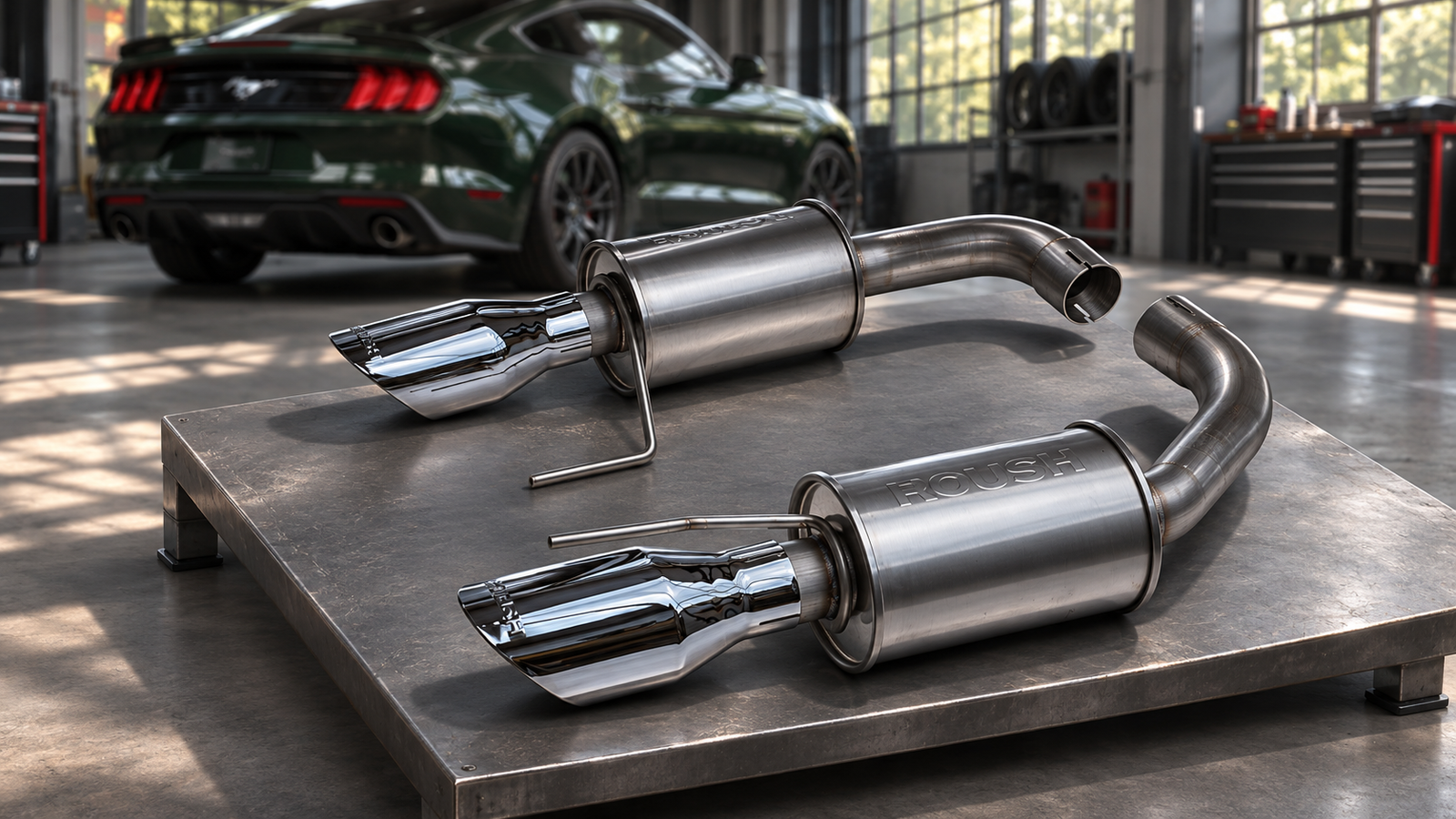
Cover: AI-created editorial styling illustration by Ultimate Stangs, based on the promoted ROUSH axle-back assemblies. The background car is illustrative; original supplier photographs appear in the product cards.
Choose a Mustang exhaust around the installed engine, body, factory valve system and the sound you want to live with. An axle-back, cat-back and resonator change are different purchases. The most useful comparison explains what is replaced, what installation requires and whether the exact kit matches your car.
This guide compares four pictured systems for different applications, from a Fox Body 5.0L to EcoBoost and active-exhaust S650 GT configurations. They are alternatives for their stated cars, not four interchangeable ways to achieve a universal horsepower figure. For broader modification priorities, our budget Mustang performance guide separates documented power packages from sound and appearance changes.
Affiliate disclosure: Ultimate Stangs may earn a commission through shopping links at no extra cost to you. This is a research-based buying guide. We have not independently tested these products, measured performance gains or ranked them using customer-vote scores.
| Purchase | What changes | What to verify |
|---|---|---|
| Axle-back | Rear muffler / tip assemblies | Cutting, clamps, active-valve hardware and valance |
| Cat-back | The listed exhaust section behind the catalysts | Connections, pipe route, body and included mid-pipe |
| Resonator / mid-pipe change | A defined intermediate section | What is retained and how existing modifications interact |
| Full installed quote | The actual job on your car | Parts, labor, cutting, connections and return-to-stock plan |
Axle-back vs. cat-back
An axle-back concentrates the purchase near the rear of the car. It can suit an owner who likes the rest of the system but wants different mufflers or tips. It is not automatically a no-cut installation: the ROUSH example below requires cutting the factory pipes. Get that requirement into the quote before treating an axle-back as the easiest reversible option.
A cat-back supplies a larger defined section behind the catalytic converters. The exact contents vary by kit: one may include an X-pipe, another a Y-pipe or different connecting sections. Read the parts list rather than assuming that “cat-back” describes an identical box across a four-cylinder EcoBoost, a pushrod V8 and a modern GT. Borla’s Mustang exhaust buying guide explains the product categories and the need for separate active-exhaust applications.
Start with the exhaust already installed. A previous owner’s mid-pipe, headers, rear valance or repair can change both fitment and the final sound. Photos of the connection points and an accurate parts history are more useful to the supplier than simply asking whether a kit fits a Mustang GT.
Set a sound target you can use
Think through a cold start near home, steady-speed commuting and a long trip with passengers. Exterior volume and cabin drone are separate questions. A system that sounds appealing in a brief acceleration clip may occupy a different part of your attention on a highway cruise. We have not measured cabin frequencies for these products, so the guide does not promise that one is universally drone-free.
Use videos to understand the demonstrated configuration, then ask about the rest of that car’s exhaust, transmission, operating mode and recording conditions. Compare the same type of drive where possible. A Race product name identifies a sound-oriented brief; it does not establish a race result, an emissions exemption or a particular increase in output.
Match the year and factory hardware
| Mustang years | Key shopping check |
|---|---|
| 1964½–1978 | Exact engine, body, exit route and installed exhaust; these featured later kits do not establish classic fitment |
| 1979–1993 Fox Body | 5.0L application, LX versus GT bodywork and existing mid-pipe |
| 1994–2004 SN95 / New Edge | GT versus Cobra/Mach 1 hardware and rear suspension / pipe route |
| 2005–2014 S197 | Exact engine and GT/Shelby application; use a separately documented kit |
| 2015–2023 S550 | GT versus EcoBoost, Fastback versus convertible, and any factory Active Exhaust |
| 2024–2026 S650 | GT/EcoBoost/Dark Horse, active-valve system and rear-valance configuration |
Factory Active Exhaust deserves its own check before a purchase. A passive kit and a kit designed to retain factory valve function are separate configurations. Confirm whether actuators or related hardware transfer from the original system, and use the instructions for the exact part number. A quiet-mode feature should not be assumed from the shape of a tip or the number of outlets.
The same care applies to body style. Supplier notes about convertible modifications are not equivalent to a straightforward Fastback installation. Ask for confirmation against the complete build, including braces and other equipment that affects space under the car. Keep removal or alteration of emissions equipment outside this shopping comparison; these selected recommendations concern their documented rear-system applications.
Four exhaust systems to compare
Fox Body: Flowmaster American Thunder
The American Thunder kit gives a Fox Body owner a chambered-muffler option rather than the straight-through systems featured later. Its supplied Super 44 mufflers, aluminized tailpipes and stainless tips make the contents identifiable. Choose it for the application and the sound character you want; a brand’s familiar exhaust note does not establish what you will hear inside your particular car at highway speed.
The LX-versus-GT distinction is the purchasing trap. CJ lists the selected kit for 1986 5.0L cars and 1987–1993 LX 5.0L models, and explicitly excludes 1987–1993 GTs. Photograph the existing tailpipe route and rear bodywork before seeking a fitment quote, especially on a modified or converted car. Compare installed cost with the required connections and existing mid-pipe, not merely the kit price.
S550 GT: ROUSH axle-back
The ROUSH option fits a buyer who wants to change the rear mufflers and tips while keeping more of the existing exhaust. Its 304-stainless construction is a concrete specification to compare with an aluminized system. The supplied two rear assemblies also make the scope of the purchase clearer than a general “exhaust upgrade” description: this is an axle-back, not a complete system from the engine rearward.
Budget for the cutting operation before ordering. CJ says the factory piping must be cut so the new sections can attach with the supplied clamps. That matters if you intend to refit the original exhaust later, want a completely reversible installation or are paying a shop. The supplier’s installation video demonstrates a 2015–2017 GT; it is useful preparation, but it does not verify another model year, body style or modified exhaust layout.
EcoBoost: MBRP Black Series
The MBRP Black Series is a different purchase from a GT muffler swap. It is a complete listed cat-back for an EcoBoost Fastback without factory Active Exhaust, with 3-inch aluminized tubing, a Y-pipe and black rear sections and tips. The Race description is central to its appeal: consider it when you actively want a more assertive sound rather than choosing it by appearance and hoping it will behave like a quiet touring system.
Material and configuration deserve separate checks. Black visible sections do not mean all of the tubing is stainless, and a Fastback listing does not establish convertible clearance. Ask the supplier to confirm the exact year, factory-active status and existing connections. Listen to the supplied EcoBoost demonstration as a reference for that installation; microphone placement, engine load and the rest of the exhaust can change what reaches your ears in daily use.
S650 GT: retain active exhaust
Factory Active Exhaust changes the decision before sound or finish enters the discussion. This Armor Pro kit is specifically listed for a 2024–2026 GT Fastback with the factory active system and quad-tip valance. Its T304-stainless tubing, X-pipe layout and carbon-fiber quad tips distinguish it from the passive EcoBoost kit above. The supplier describes retention of the factory active function on that configuration.
Have the installer explain what factory hardware must be transferred and confirm the exact instructions before booking the job. The selected Fastback application is deliberately narrower than a promise that every S650 will accept it. Convertible fitment can involve additional modifications, and a GT listing is not automatic Dark Horse approval. Compare the total installed quote and your preferred quiet and loud operating modes, while keeping sound preference separate from an unverified horsepower claim.
Watch the relevant installation
These supplier demonstrations help show the scale of the job and provide a sound reference for the pictured build. The earlier ROUSH clip relates to the featured S550 application; the MBRP video demonstrates an active-exhaust S650 system. They do not constitute our own installation or sound test.
Video: CJ Pony Parts. Archival 2015–2017 GT demonstration. Cutting and final sound are specific to the installation shown.
Video: CJ Pony Parts. S650 GT supplier installation and sound demonstration; verify the current instructions for your exact kit.
Compare the complete installed cost
Ask the shop to separate the kit, installation labor, clamps or adapters not supplied, and any work needed to address existing modifications. If keeping the original exhaust matters, discuss storage and the effect of cutting before the job begins. A lower parts price can describe a smaller scope of work rather than a better value for the same result.
Compare aluminized and stainless construction using the exact specification, finish care and intended environment. A black visible section is not proof of stainless tubing, and polished tips do not identify the material of the entire system. Inspect the supplier’s current warranty and installation conditions for the exact part rather than assigning one warranty to a whole brand.
Before ordering, write down the engine, body, factory-active status, current exhaust and desired sound character. That short specification helps the supplier answer a concrete fitment question and helps you compare a quote on equal terms. Use the product photographs and descriptions together: an installed view can show the finished appearance while the contents list establishes what is actually supplied.
Buying questions
Will a cat-back add horsepower?
A cat-back label alone does not establish a power gain on your engine. This guide compares documented contents, construction, application and sound brief; it does not assign an independent dyno result.
Does an axle-back always bolt on without cutting?
No. The featured ROUSH CBR19 installation requires cutting the factory pipes and using the supplied clamps. Read the exact kit instructions.
Can a passive kit fit a factory-active Mustang?
Do not assume so. Match the factory valve system and confirm whether the selected kit retains its function and requires transferring hardware.
Will a Fastback exhaust fit a convertible?
Only use a documented application for the exact body and equipment. A note that modifications may be required is not a universal bolt-on approval.
Are all four recommendations compatible with the same car?
No. They address different years, engines, bodies and valve configurations. Each card states its featured application and exclusions.
Sources and selection method
Applications, package details, supplier media and joined-affiliate links checked November 20, 2026. Sources include the linked exact CJ Pony Parts listings, their supplier installation videos and Borla’s exhaust-category guidance. Stock, promotions and installation requirements can change. Selection reflects documented fitment and buying trade-offs; no independent sound, emissions, fuel-economy or horsepower test was performed.

