

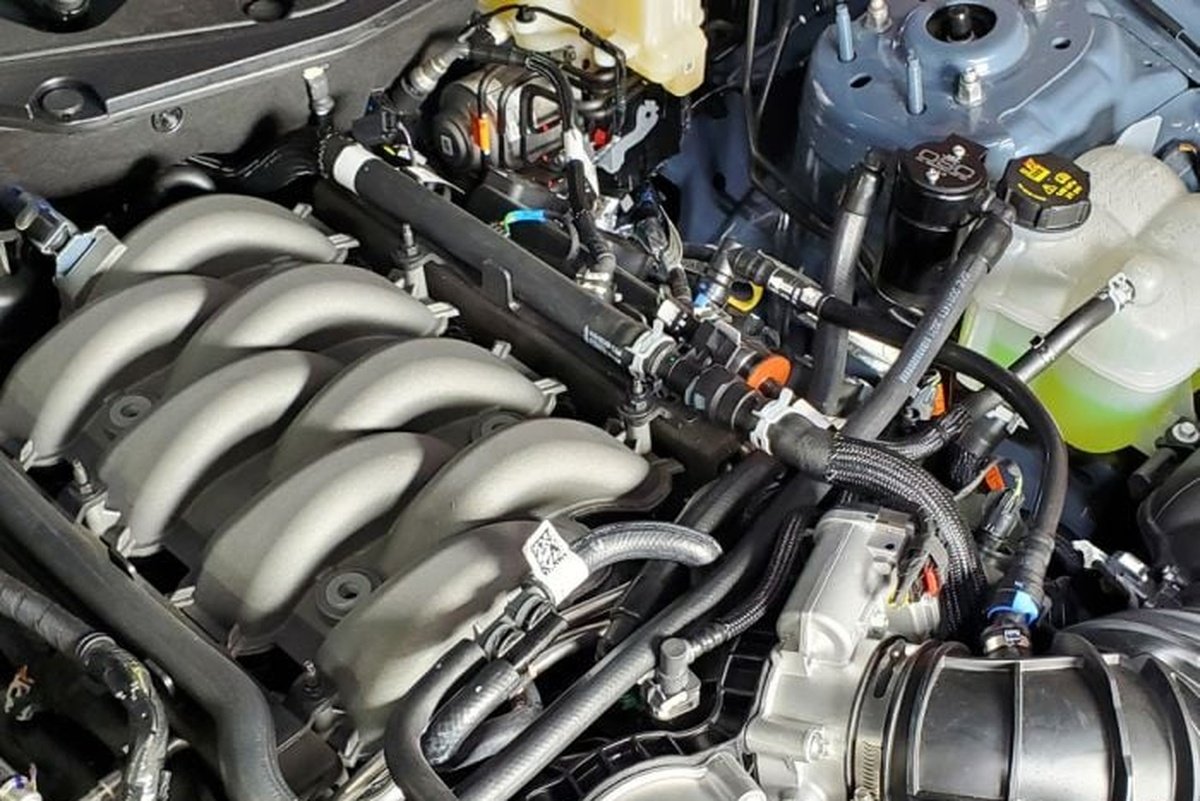
Cover: J&L oil separator shown in the supplier’s Mustang engine-bay installation photo. Photo: CJ Pony Parts. Pictured hardware and routing are specific to that application.
A Mustang oil catch can or separator must match the installed engine’s crankcase-ventilation route, modifications and permitted use. It collects material from that route and adds a container you must check and empty. Its presence is not evidence of a horsepower gain or a cure for an engine fault.
This guide compares four photographed kits for S550 EcoBoost, S550 GT and S650 GT/Dark Horse applications. The featured seller pages state that these items are not CARB exempt and are not legal for sale or use in California. Resolve that restriction and the exact application before treating any of them as a shopping recommendation for your car.
Affiliate disclosure: Ultimate Stangs may earn a commission through shopping links at no extra cost to you. This is a research-based buying guide. We have not independently tested these products, measured performance gains or ranked them using customer-vote scores.
| Question | Why it changes the purchase |
|---|---|
| Which engine and year? | Hoses, brackets, connectors and PCV routing differ |
| Naturally aspirated or modified? | Superchargers and other changes may require a different kit |
| Which side and ventilation route? | Clean-side and PCV-side products are different applications |
| What use is permitted? | Physical fit does not override the seller’s stated restrictions |
| How will it be serviced? | Access, conditions and actual collected contents determine the ownership task |
What an oil separator does
The crankcase-ventilation system moves gases through a defined route back toward the engine’s intake. An application-specific separator places a collection/filtering arrangement in its intended part of that route. J&L’s manufacturer FAQ describes capturing oil vapor and contaminants before they re-enter the intake. The relevant buying question is how the exact kit fits and is serviced, rather than whether every Mustang needs an additional can.
A container that collects material adds maintenance. Its capacity is not a tested capture-efficiency percentage, and the quantity collected in one owner’s car does not establish what yours will collect. Driving pattern, operating conditions and the installation can differ. This guide does not claim an independently measured horsepower, fuel-economy or engine-life improvement.
If you are investigating oil consumption, smoke, an existing ventilation fault or poor running, diagnose the cause before buying an accessory as a cure. A new container does not identify the reason for those symptoms. Our Mustang spark-plug guide likewise separates documented service applications from unsupported performance promises.
Choose the correct ventilation route
Driver-side, passenger-side, clean-side and PCV-side labels are not interchangeable shopping terms. Read the exact kit instructions to see which hose route is changed, where the can mounts and what remains connected. The hoses and brackets supplied with one generation’s kit are part of its application, not generic accessories to carry over because another can looks similar.
Modifications can change the answer again. An oil separator listed for a naturally aspirated GT is not automatic approval for a Whipple, Roush or other supercharged layout. The selected 2018–2023 J&L GT listing explicitly excludes supercharged cars. Give the supplier the actual intake, supercharger and ventilation arrangement when checking a modified build.
For the newer S650 choices, we checked the expanded supplier fitment panels: they list 2024, 2025 and 2026 GT/Dark Horse years, while some description text emphasizes 2026. That year check is useful, but it does not remove the need to confirm trim, engine configuration and modifications. A model year alone cannot resolve a changed hose layout.
Resolve use restrictions first
The featured CJ listings identify all four selected items as not CARB exempt and not legal for sale or use in California. J&L also publishes a manufacturer terms document containing its CARB notice. Read the exact current restriction and confirm that your proposed use is permitted before ordering; this comparison does not establish road-use approval for another jurisdiction.
Do not read “direct fit,” “plug and play” or an OEM-style connector as an emissions approval. Those phrases concern the physical product or installation. Keep evidence for the exact part and use separate from a generic claim about catch cans. If the application or permission is not established, resolve it with the supplier before making the purchase.
Four application-specific kits
S550 EcoBoost: J&L driver-side kit
The 3029D-B addresses the S550 EcoBoost’s driver-side arrangement with a defined can, hoses and connectors. That is the benefit of an application-specific kit: you can assess its mounting, hose route and service access against the car before ordering. Its 3oz capacity is a container specification, not a measured capture-efficiency result or proof that another brand needs less frequent attention.
Plan for the ownership task as well as the installation. A container that must be emptied needs accessible placement and periodic checking, with an interval established from the actual contents and driving conditions. The retailer’s generic mileage language is not a universal drain schedule. Also resolve permitted use before shopping: CJ identifies this item as not CARB exempt and not legal for sale or use in California. A good physical fit alone does not settle that separate question.
S550 GT: J&L passenger-side kit
The 3024P-B moves the comparison to the naturally aspirated 2018–2023 GT and its passenger-side route. Its two-stage filtering arrangement and 3oz body belong to this exact kit. The practical shopping distinction is not simply whether a can is labeled “for a Mustang”: the bracket, hose layout, connectors and installed engine configuration determine whether the complete package is suitable.
The supercharger exclusion is especially important for a used or modified GT. CJ specifically says this kit is not designed for cars with a supercharger, so do not carry the naturally aspirated application over to a boosted build. Ask for the correct system-specific arrangement instead. As with the EcoBoost product, verify use restrictions and plan to monitor the collected contents; neither the common body size nor the familiar brand establishes an identical service interval.
S650: J&L PCV-side separator
The S650 kit is useful for showing why a newer generation deserves its own application check. CJ’s expanded fitment panel lists 2024, 2025 and 2026 GT/Dark Horse applications, while the description emphasizes 2026. We checked both rather than relying on the shortened feed title. The can has a 3oz capacity and a removable knurled base, with the kit’s hoses and bracket forming part of the fitment decision.
Compare service access and the supplied route with your actual engine bay, especially after an intake or forced-induction change. The manufacturer-style installation video demonstrates a 2024 GT; it helps explain that installation without proving compatibility for every later modified car. Ask the supplier to confirm your exact build and permitted use. The common S650 name does not remove the retailer’s stated emissions restriction or the need to empty the container.
S650 alternative: UPR single-valve kit
UPR gives the S650 owner another complete package to compare, with billet-aluminum construction, a single-valve can and quick-release hose connections. Start with the exact 5028-292-1 specification and supplier instructions rather than comparing the shapes of two black canisters. Hose connection style, access to the mount and the emptying routine can matter more to ownership than a generic claim about extra engine performance.
The listing also needs a careful contents check. One bullet mentions a clean-side can, while the specific kit list identifies a single-valve can and its hoses and fittings. We do not treat that wording as proof that a separate clean-side assembly is supplied. Confirm the contents, exact build and use restrictions before ordering. Similarly, a naturally aspirated single-valve selection does not establish suitability for a Whipple, Roush or other supercharger installation.
Watch the matching supplier installation
The EcoBoost film concerns the driver-side S550 J&L application, while the newer film demonstrates the S650 GT J&L installation. They show different engine-bay arrangements. Neither is proof that a generic can, a different brand’s hose kit or a supercharged build uses the same procedure.
Video: CJ Pony Parts. Archival supplier installation for the stated EcoBoost kit; verify the current instructions.
Video: CJ Pony Parts. Supplier demonstration on a 2024 GT. Check the exact application and restrictions for your current build.
Plan emptying and inspection
Check service access before choosing a mounting position or comparing two kits. A can that is difficult to reach may be inconvenient to inspect, even if its mounting looks tidy. Follow the manufacturer’s initial checking guidance and establish an appropriate interval from the actual contents and conditions. Do not convert a retailer’s general mileage suggestion into a universal emptying schedule.
Keep the drain/emptying instructions with the car and inspect the installation as the manufacturer directs. A larger advertised capacity may change the container dimensions, but it does not remove the need to check the hoses, connections and contents. Never treat the can as a substitute for the engine’s required oil-level checks or scheduled maintenance.
Before buying, compare the complete kit list, mounting route, connection system, permitted use and delivery. Ask about any ambiguity in the listing. The UPR example is a useful reminder: a broad bullet can mention a clean-side can while a more specific contents list describes one single-valve assembly. Written confirmation is more useful than assuming the extra item will be in the box.
Buying questions
Does every Mustang need an oil catch can?
This guide does not establish that. Start with the installed engine, ventilation arrangement, manufacturer requirements, intended use and the added maintenance task.
Will a catch can add horsepower?
We have not measured a power gain for these kits. Capacity and filtering descriptions do not establish an independent horsepower or fuel-economy result.
Can the same kit be used on a supercharged GT?
Only use an application documented for the actual supercharger and ventilation configuration. The featured J&L 2018–2023 naturally aspirated GT kit explicitly excludes supercharged cars.
Are the featured kits CARB exempt?
Their seller pages state that they are not CARB exempt and are not legal for sale or use in California. Confirm permitted use for the exact part and your application before purchase.
Does the featured UPR kit include a separate clean-side can?
The listing has inconsistent wording. Its specific kit list identifies a single-valve can and connections, which does not establish that a separate clean-side can is supplied. Confirm the contents with the seller.
Sources and selection method
Current exact product listings, expanded year-fitment panels, supplier photographs, videos and joined-affiliate links checked November 20, 2026. Primary references include the four linked CJ Pony Parts offers, J&L’s FAQ and manufacturer notice, and the supplier’s application-specific installation material. We report listing conflicts and restrictions rather than inferring universal fitment, road-use approval or tested performance. No independent collection-efficiency, longevity or power testing was performed.

