

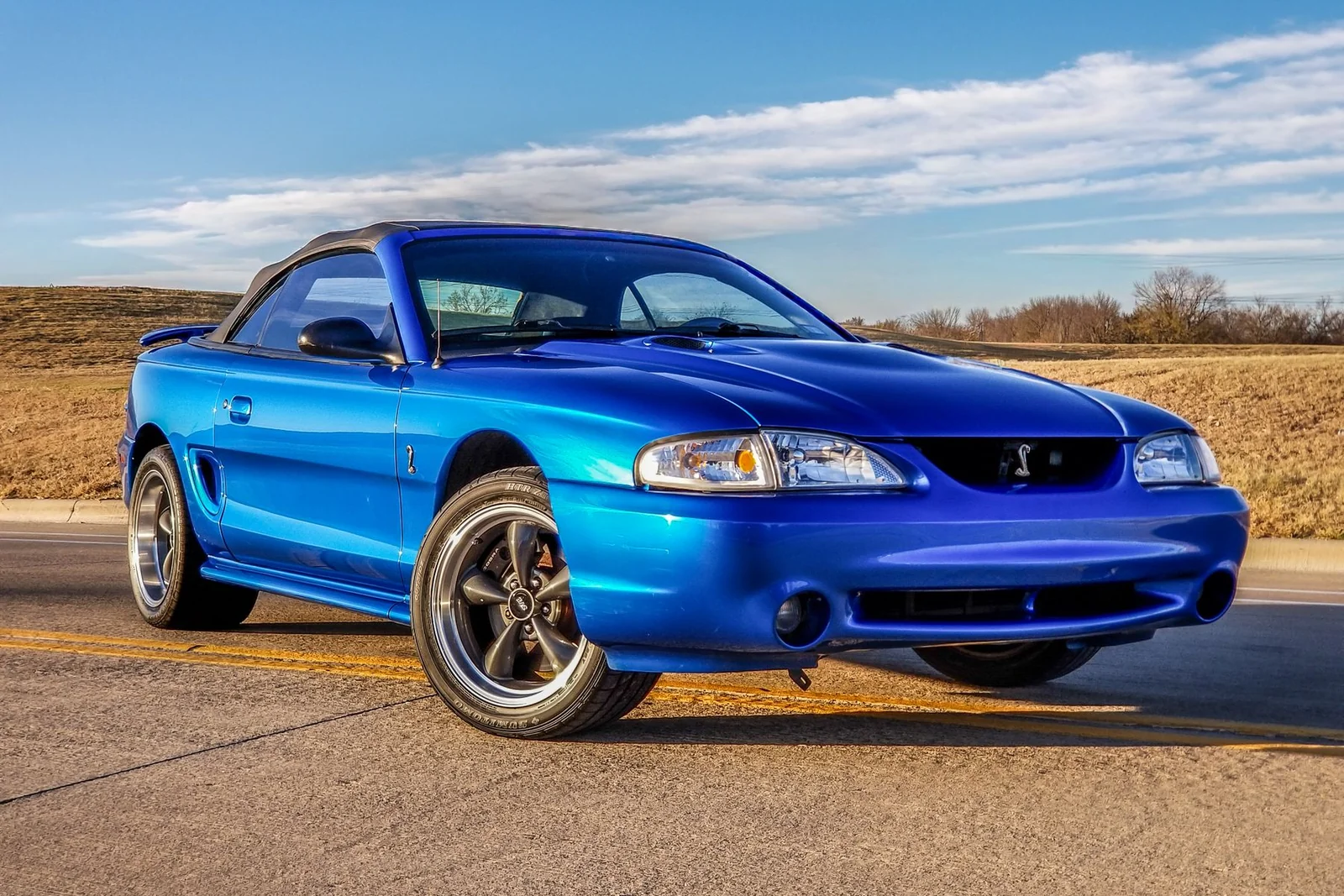
A convertible roof can look clean from across the driveway while holding grit in the weave, residue at a seam, or dampness in a folded section. The useful question is not simply which bottle to buy. It is which material is actually on your Mustang—and what its maker permits you to use.
Quick answer: Identify the installed top as fabric or vinyl, follow its manufacturer’s cleaning instructions, and let it dry completely before lowering it. A cleaner or protectant approved for one material is not automatically appropriate for the other. Replacement tops make the car’s model year an unreliable shortcut.
Advertising disclosure: Display advertisements contain affiliate links. Ultimate Stangs may earn a commission if you purchase through them. Advertisements are separate from the maintenance recommendations below.
Start with the roof that is installed, not a model-year guess
Check the roof’s paperwork, replacement invoice, supplier label, or installer record. A used Mustang may have had more than one top. A woven-looking surface can guide your questions, but it does not establish the exact fabric, coating, or care requirements. If records are missing, ask a convertible-top specialist to identify it before using a stain treatment.
Build a short care note containing the material or product name, maker, approved cleaner, and any restrictions. Keep a picture of the relevant instructions with the car’s records. This is particularly helpful when another person details the car: “soft top” does not tell them enough.
| Decision | Fabric / cloth top | Vinyl top |
|---|---|---|
| First check | Identify the installed fabric and its maker’s instructions. | Identify the installed vinyl and its maker’s instructions. |
| Cleaning product | Use a product specifically approved for that fabric. | Use a product specifically approved for that vinyl. |
| Protection | Fabric protectant, only when the roof maker specifies it. | Vinyl protectant, only when specified; not a substitute for fabric treatment. |
| Before lowering | Top, folds, and seams must be dry. | Top, folds, and seams must be dry. |
| Uncertain history | Ask the installer or material manufacturer. | Ask the installer or material manufacturer. |
A practical hand-cleaning routine
Choose a shaded place where you can leave the roof raised afterward. Read the cleaner’s current label before wetting the car, including its dwell time, rinse instructions, and surrounding-surface precautions. Collect soft, clean tools that have not been used on wheels. An aggressive brush is not a shortcut to a cleaner top.
Plan the wash around drying
Identify
Confirm material, approved product, and instructions.
Remove loose dirt
Use an appropriate soft tool without grinding grit into seams.
Clean and rinse
Follow the roof and cleaner instructions; keep residue off nearby trim.
Dry fully
Leave the roof raised. Check folds before lowering or covering.
1. Remove loose contamination before scrubbing
Start with loose debris so that contact cleaning does not simply move grit around. Ford’s 2026 Mustang manual describes gentle lint removal and a soft-bristle vacuum attachment. Use the manual for your own model and the instructions for any replacement roof. Stop if a seam, window bond, or surface is already separating.
2. Clean with a material-approved product
Apply and work the product as directed. Divide the job into manageable areas so you can monitor them and rinse when required. Do not let the need to finish before sunset tempt you into a stronger mixture. Photograph a stubborn stain first; its location, appearance, and cleaning history are useful information for a specialist.
The Haartz fabric and vinyl care guide separates material-specific treatment and protection. Its instructions are for its named materials, not a license to apply every listed treatment to every replacement top. This guide deliberately does not prescribe a universal bleach mixture or a fixed soak time.
3. Rinse carefully and allow a complete dry
Keep runoff under control and follow the specified rinse method. Ford warns that high-pressure water can cause roof leaks and seal damage. A pressure washer that is useful elsewhere on the car should not become an excuse to blast the roof, seams, or window edges.
Leave enough time for drying with the roof up. Inspect folds and seams rather than judging only the exposed center panel. If the car must be moved, keep the roof raised until it is fully dry. A short drive with the roof down is not a substitute for checking damp folds.
The drying check before a top-down drive
Make this a separate part of the job. Put the wash equipment away, return to the car, and inspect the areas that are easiest to overlook. That pause prevents the satisfying “finished” moment from turning into an immediate wet fold.
When protection, stain removal, or a leak needs a different plan
Cleaning removes contamination; a protectant has a different job. Check whether the roof maker calls for one, which exact material it covers, and how dry the surface must be. Keep overspray off surfaces the label excludes. Do not assume that more product, stronger water beading, or a darker appearance proves a better result.
For a recurring damp area, lifting window edge, damaged seam, or difficult stain, stop experimenting and ask a qualified top specialist. Tell them what has already been used. A leak can involve seals, fit, drainage, or damaged material; spraying a coating over it does not diagnose the cause. Avoid probing drains or dismantling trim without the proper service instructions.
A roof-cleaning product to consider
Start with the roof maker’s instructions, then compare the cleaner’s label. A product sold for leather seats or interior vinyl is not automatically suitable for an exterior soft top. The option below is for cleaning, not waterproofing or repairing a leak.
Fit roof care into the rest of your Mustang routine
Plan roof care as its own material-specific step, then follow a separate body-wash routine. Our Mustang washing and maintenance guide covers the broader wash, while our foam gun versus foam cannon comparison explains equipment differences. Neither makes a body shampoo or foaming accessory automatically suitable for a convertible top.
Before a longer layup, use the roof maker’s storage guidance along with our Mustang winter storage checklist. Haartz recommends an up, closed roof for extended storage and warns against putting it away wet. Check the car’s model-specific operating and temperature instructions before moving the mechanism.
Mustang convertible top care FAQs
Can I use ordinary car shampoo on the top?
Only if the installed roof’s manufacturer explicitly permits that product or type of cleaner. Approval for painted bodywork does not establish compatibility with a soft top.
Does the model year tell me whether it is fabric or vinyl?
It does not reliably identify a replacement roof. Use the installed top’s paperwork or a qualified specialist rather than ordering a treatment from the model year alone.
Can I lower the roof while it is still damp?
Wait until it is fully dry. Moisture trapped in folded material is a different situation from water on an open, drying roof. Follow the top maker’s instructions.
Do I need a new cleaner every time?
You need a compatible product and clean tools, not a bigger collection of bottles. Recheck labels when a formula, roof, or finish changes.
A better habit than guessing
Identify the material once, document its care requirements, and leave time for drying every time. That approach is more useful than choosing a strong cleaner first and trying to work backward. Keep maintenance notes with the roof records so the next cleaning starts with a known plan.
Sources and image credits
Researched November 12, 2026 using Ford’s 2026 Mustang owner’s manual, printed pages 371–372 and convertible-top operating notes, and Haartz’s cloth and vinyl care guide. These are source-based maintenance recommendations, not a hands-on product test. Consult the manual and material instructions for your actual car.
Featured photo: Ryan Stephens / Pexels. Pexels-licensed illustrative photography; no endorsement implied.

