

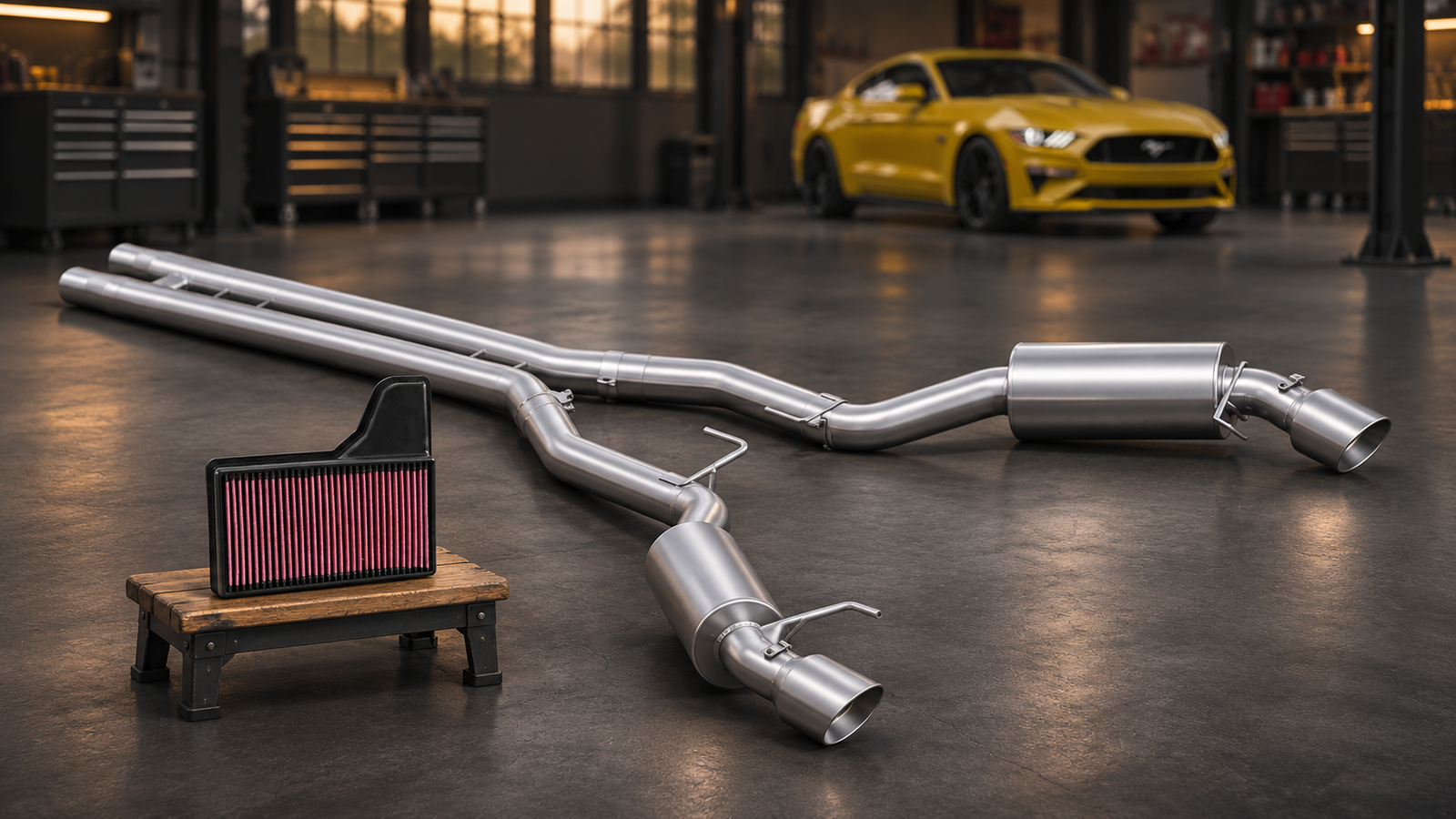
Cover: AI-created editorial composite by Ultimate Stangs using supplier product references. The background car is illustrative; verify each product’s separate fitment. Original supplier photos appear below.
The cheapest Mustang horsepower is the gain you can verify before buying the part. An intake, filter or exhaust can be worthwhile, but its value depends on the engine, calibration and hardware already on the car. A louder drive is not evidence of additional power.
These five budget-minded choices help you prioritize a healthy street Mustang. Some can support documented gains in a specific application; others restore lost performance or improve the experience without a promised horsepower increase. This is a research-based guide, with no Ultimate Stangs dyno testing or invented combined-gain figure.
Set a budget for the complete change
Before comparing parts, write down the model year, engine, transmission, existing intake and exhaust, and any current tune. For an older car, identify engine swaps and previous-owner changes as well. A 5.0 badge is not a complete fitment specification across Fox Body, S197, S550 and S650 Mustangs.
Budget for installation, required calibration, fuel requirements and related hardware. A cheap component that needs a second purchase before it works is not necessarily the cheapest route. Decide whether your goal is a measurable power increase, a different sound, or a more enjoyable daily drive; each can be legitimate, but they should not be sold as the same result.
1. Recover performance before adding parts
Start with faults, not a modification list. A car with a warning light, misfire, dirty or damaged filter, intake leak or overdue maintenance needs diagnosis first. Returning it to proper condition may restore performance, but that is not an aftermarket horsepower gain above a healthy stock baseline.
Follow the maintenance specification for the exact engine rather than installing a different spark plug or fuel grade because an online post promises extra power. Our spark plug guide can help organize the questions, while the vehicle documentation and the actual engine setup establish the part and service requirements.
For an owner with a limited budget, a basic inspection is especially useful because it may show that the next purchase should be a replacement component. Keep receipts and a record of the car’s condition so a later before-and-after comparison has a meaningful starting point.
2. Treat a panel filter as a modest purchase
A replacement panel filter can be an accessible first step when it fits the existing airbox and suits your maintenance preferences. Compare an ordinary replacement with a reusable design on purchase cost, cleaning requirements and exact application. Do not assign a universal horsepower number to the choice.
The K&N 33-5029 card below is for the listed factory airbox applications: 2015–2023 GT and EcoBoost, plus 2015–2017 V6. Check the shape and part number against your airbox, particularly if a previous owner fitted an aftermarket intake. Paying for a performance filter that does not fit the current housing is an avoidable mistake.
Our view: choose a filter because it makes sense as part of a service or a documented package. A clean, healthy stock system should not be described as broken simply to justify an upgrade.
3. Compare an exact calibration package
Calibration is where a specific manufacturer-supported combination can be more informative than a generic claim about “a tune.” Ford’s M-9603-M8 package for the 2015–2017 Mustang GT combines a calibration with a K&N panel filter. Ford lists peak gains of 13 hp and 16 lb-ft for that package, as well as a different torque gain at a specified lower engine speed.
Those are Ford’s published package figures, not our measurements and not a promise for an already-modified car. The distinction between a peak increase and a gain at one engine speed matters: neither should be added casually to every other part’s advertised number. Read the exact Ford package specification.
A current option for the 2018–2023 EcoBoost
The pictured M-9603-M4CA package is for a different application: the 2018–2023 EcoBoost, excluding 2020–2023 2.3 High Output cars. Ford lists a 35-hp gain at 2,900 rpm and a 76-lb-ft gain at 2,600 rpm, rather than a blanket promise that the engine’s maximum rating increases by both amounts at the same point. Premium fuel is required for maximum performance, and the calibration is developed for US and Canadian vehicles. Read Ford’s M-9603-M4CA requirements.
Confirm availability, the required fuel and installation process before purchase. Ask how the package interacts with your current hardware and whether you would need to remove or replace an existing calibration. A package approved for a 2015–2017 GT is not an instruction to load that software into a newer GT, an EcoBoost or a swapped classic.
4. Buy an intake as a matched system
An intake makes more sense when you understand the full system it belongs to. Check whether calibration is required, which engine and model years are covered, and what existing equipment it replaces. A throttle body, intake tube and software combination should be evaluated as the specified combination, rather than three separate advertised gains.
Ford’s M-9603-M8B listing provides a useful example for its stated 2018–2021 GT application: it combines intake hardware, an 87 mm throttle body and calibration. Ford publishes gains at particular engine speeds. It is a more substantial purchase than a panel filter and should be compared as a step-up package, rather than called cheap simply because it costs less than forced induction. See Ford’s package details and exclusions.
For a daily driver, work out the total cost before ordering the hardware. A smaller, complete change that suits the car can be more useful than the first half of a larger upgrade. If the vendor cannot explain the fitment and calibration requirement clearly, pause that purchase and resolve those questions.
5. Choose exhaust for the right reason
An axle-back or cat-back can change the character of a Mustang, and sound is a real reason owners buy one. It should still be described honestly. Without relevant testing of the exact combination, do not treat an exhaust video or a larger pipe diameter as proof of a particular horsepower gain.
Compare the year, engine, body configuration, factory active-exhaust equipment, tip arrangement and the precise components replaced. A system that bypasses or removes factory active valves can change functionality you wanted to retain. Listen to steady-speed cabin audio as well as a start-up clip; the sound you hear every day matters more than one dramatic rev.
The pictured S7253AL is MBRP’s Race-profile Armor Lite cat-back. The recommendation is limited to CJ’s 2024–2026 GT Fastback application without factory Active Exhaust. It is not the quiet Street-profile alternative, despite inconsistent wording in some supplier descriptions. MBRP’s part listing identifies the profile and construction.
Keep the emissions equipment and product’s intended road-use application in the decision. This guide does not recommend removing catalytic converters or disabling emissions controls. Ask the manufacturer to identify a compliant application for the exact vehicle and location when calibration or exhaust changes are involved.
Watch an earlier GT package on the dyno
Video: Late Model Restoration. Archival retailer demonstration of the earlier GT package discussed above. Its results do not apply automatically to the current EcoBoost or GT packages, and are not our own testing.
How to read a horsepower claim
Ask for the baseline, the modified configuration and the test method. Engine output and wheel output are different measurements. A change at peak power is different from a gain at a particular rpm. Weather, fuel, correction method and other modifications can also affect a comparison.
Most importantly, do not add a filter claim, an intake claim and a tune claim together when those parts replace one another or were tested as one package. The useful question is what the complete combination has demonstrated relative to the baseline you actually have.
| Choice | What to verify | What we will not assume |
|---|---|---|
| Maintenance | A diagnosed fault or service requirement | Power above a healthy factory baseline |
| Panel filter | Airbox and part-number compatibility | A universal horsepower increase |
| Calibration package | Exact engine, years, fuel and hardware | That results transfer to every Mustang |
| Intake system | Calibration and complete installed cost | That separate claims can be added together |
| Exhaust | Fitment, valves, sound and relevant testing | That louder automatically means faster |
Our budget performance verdict
Buy in this order: establish a healthy car, define the result you want, verify an exact application, then price the whole change. If you specifically want horsepower, prioritize evidence for the complete package. If you want exhaust sound or a different driving feel, buy for that purpose without attaching an unsupported power claim.
Budget Mustang upgrade questions
What is the cheapest way to add horsepower to a Mustang?
There is no universal answer across engines and model years. Diagnose faults first, then compare exact packages with published results and a complete installed cost. A low purchase price alone does not establish value.
Will an exhaust add horsepower without a tune?
The result depends on the exact system and vehicle. This guide does not assign a gain without relevant evidence. Many buyers choose an axle-back or cat-back primarily for its sound and construction.
Can I add the horsepower claims from different parts?
Not reliably. Claims may use different baselines or describe overlapping components within one package. Look for testing of the actual complete combination.

