

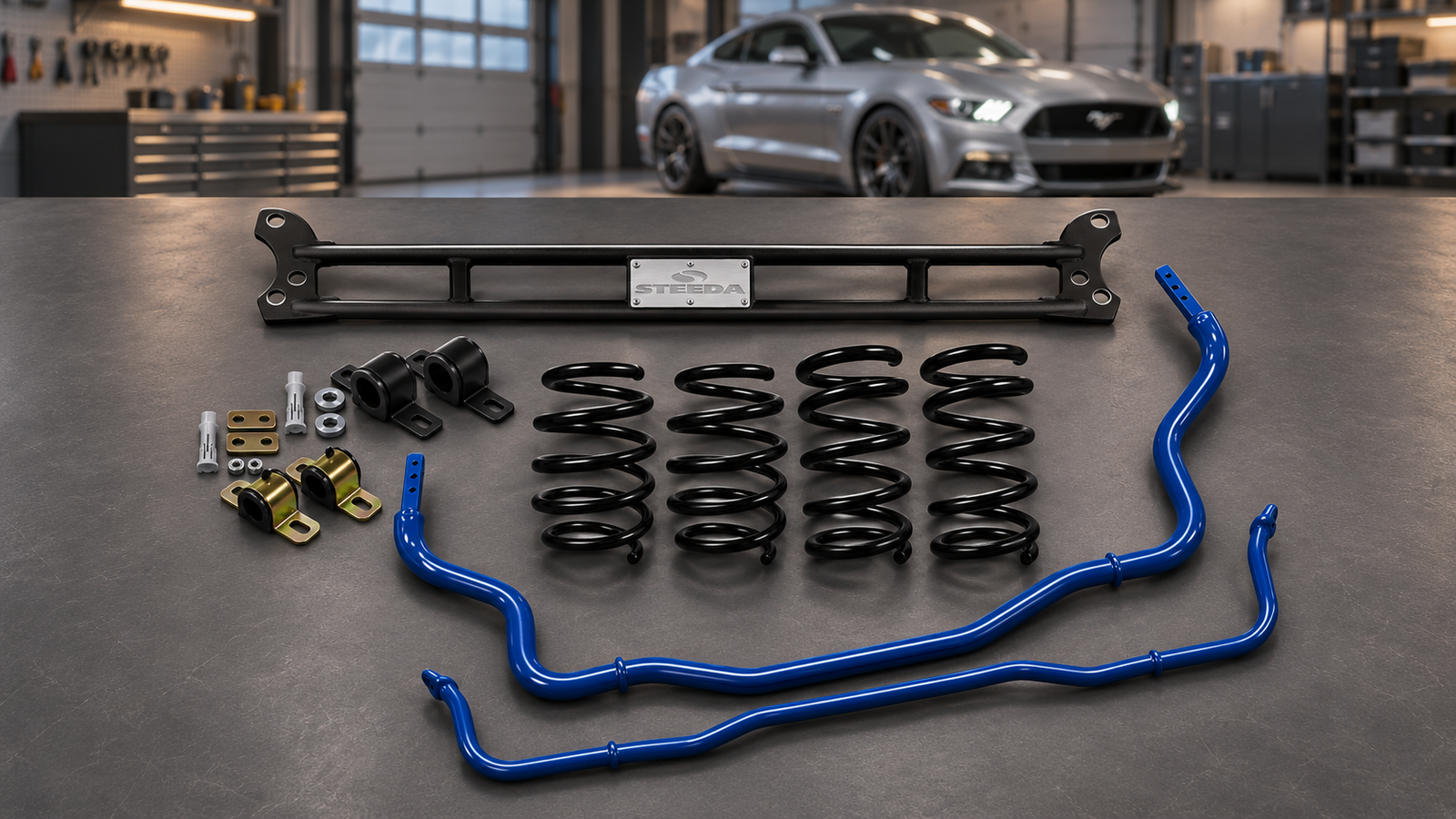
Cover: AI-created editorial composite by Ultimate Stangs using supplier product references. The background car is illustrative; verify each product’s separate fitment. Original supplier photos appear below.
A good Mustang suspension upgrade fixes a clear problem: worn control, excessive movement, or a stance that does not suit the way you use the car. Springs, dampers and sway bars change different things. Buying them as interchangeable promises of “better handling” can leave you with a harsher car and another shopping list.
This guide explains how to choose an upgrade in stages, with pictured options for specific Mustang applications. It is a research-based buying guide, not a road test. The product’s exact fitment and your existing suspension take priority over the generation name on a box.
Start with the complaint, not the catalog
Describe what you want to change in ordinary language. Does the car continue moving after a bump? Is the ride height mainly a styling concern? Does it feel loose because parts are worn? Is it a street car being prepared for occasional track use? These questions lead to different purchases.
Inspect the current system before choosing an upgrade. Worn bushings, leaking dampers, damaged mounts or poor alignment can make a healthy factory design feel inadequate. Replacing a worn part with an appropriate fresh one is a different decision from increasing spring rate or changing roll stiffness. Ask the installer to identify which problem each proposed part addresses.
Tires belong in the same conversation. Suspension parts cannot make an unsuitable tire appropriate for freezing weather, and a tire change can alter the behavior you were trying to fix. Read our tire pressure guide, then confirm the tire and wheel setup before deciding the car needs a more aggressive chassis package.
What each suspension upgrade changes
| Part | Main reason to consider it | Trade-off to discuss |
|---|---|---|
| Springs | Ride height and support | Travel, clearance and damper compatibility |
| Shocks and struts | Control of suspension movement | Condition, calibration and adjustability |
| Sway bars | Roll stiffness and balance | Front/rear combination and street behavior |
| Matched handling kit | A coordinated set of components | Exact contents and what it leaves out |
| Alignment parts | Achieving the required settings | Whether the measured car actually needs them |
Lowering is not a complete handling strategy. Less wheel gap can look right while leaving less room for bumps, steep driveways or an exhaust system that already sits low. A drop quoted by a manufacturer is an application-specific approximation, not a guaranteed measurement for a car with unknown springs or other changes.
Choose by year and factory equipment
Organize the search chronologically: classic 1965–1973 cars first, then 1974–1978 Mustang II, 1979–1993 Fox Body, 1994–2004 SN95/New Edge, 2005–2014 S197, 2015–2023 S550 and 2024-on S650. This keeps the shopping list readable without implying that parts fit every trim within those periods.
Body style, engine and special editions can change the application. Write down whether your newer Mustang has MagneRide before comparing spring or damper kits. An ordinary shock or strut package is not automatically a substitute for an electronically controlled system. On an older modified car, identify what is fitted now rather than assuming the original specification remains underneath.
1979–2004: a spring kit with exclusions
The Ford Racing M-5300-C kit gives Fox Body and SN95 owners a spring-only comparison. Ford lists different approximate drops for the earlier cars and the 1994–2004 application, and excludes the 1999–2004 Cobra. Its independent rear suspension is a reason to stop and verify the exact application rather than shopping by the body’s appearance.
Ford also notes possible ride-quality deterioration. That makes the existing dampers and intended use part of the buying decision. A spring kit does not include a cure for worn shocks, bushings or mounts. Read Ford’s application table and exclusions.
2005–2014 GT Coupe: track-oriented springs
The M-5300-PA set is a more focused spring option for its stated GT Coupe application. The supplier lists approximately one inch of lowering. Compare it with the way the car is actually used: a driver seeking a modest street refresh and an owner preparing a track-oriented setup may reasonably choose different components.
Do not expand the GT Coupe listing to every V6, convertible or Shelby in the S197 generation. Check the exact vehicle and damper combination before ordering. See the exact M-5300-PA listing.
2015–2023 GT: a coordinated handling package
The Steeda SUSK32 package combines lowering springs, front and rear sway bars, bushings and a strut-tower brace. Replacement shocks and struts are not included. CJ Pony Parts excludes factory MagneRide, and the brace is for left-hand-drive cars.
Compare this as a complete installation, including a separate check of the current dampers. Confirm what the shop will reuse, which hardware must be replaced and whether alignment components are additional. A package price does not answer the total-cost question. Check the kit contents and exclusions.
2015–2023: a spring-only street alternative
The M-5300-XA street springs provide a narrower alternative to the Steeda package. The supplier lists 2015–2023 GT and EcoBoost applications, plus the 2015–2017 V6, and specifically excludes factory MagneRide. The approximate one-inch drop should be evaluated alongside available travel and the condition of the dampers.
MagneRide owners should search a dedicated compatible product. Do not buy the spring-only option because the year range matches and assume the electronic suspension will make the rest work. For newer S650 cars, start a fresh exact-year search rather than transferring an S550 product recommendation. See the M-5300-XA application notes.
Build a useful installation budget
Ask for a written total that separates parts, labor, necessary hardware and alignment. If the car has substantial mileage, discuss mounts, bushings and other wear items while the suspension is apart. Reusing a tired component because it was not pictured in the kit can undermine the reason for doing the work.
Agree on the intended street use before selecting alignment settings. A setup intended to support repeated track work may introduce wear or daily-driving compromises you did not want. There is no single alignment specification in this article because the vehicle, parts and driving brief need to establish it.
Clearance deserves a deliberate check after lowering. Include the tires at steering lock, the exhaust, driveways and the surfaces where the car is normally parked. If an exhaust upgrade is also planned, coordinate the two jobs instead of treating ground clearance as somebody else’s problem.
Watch the supplier’s handling-kit overview
Video: CJ Pony Parts. Supplier overview of the stated GT package; it does not establish fitment for other years or MagneRide cars.
Our recommended upgrade order
For a street Mustang, begin with inspection and correction of worn components, then establish tire condition and alignment. After that, choose either a modest, compatible change aimed at a specific complaint or a matched package with a defined purpose. Leave room in the budget for installation and the checks afterward.
That order gives each purchase a job. It also makes it easier to recognize when you have reached a setup that suits the car, rather than continuing to buy parts because a catalog has another stage.
Mustang suspension questions
Do lowering springs add horsepower?
No. They change the suspension and ride height. Their value should be judged by compatibility, clearance, control and the driving purpose, rather than an engine-power claim.
Can I fit ordinary lowering springs to a MagneRide Mustang?
Use only a product explicitly approved for the exact MagneRide application. Some spring kits specifically exclude it. Confirm model year, trim and body style with the manufacturer or seller.
Should I buy springs or a complete handling kit?
Springs may address a narrow ride-height goal when compatible with the existing dampers. A matched kit can coordinate more components. Compare the complete installed cost and the problem each part solves.

