

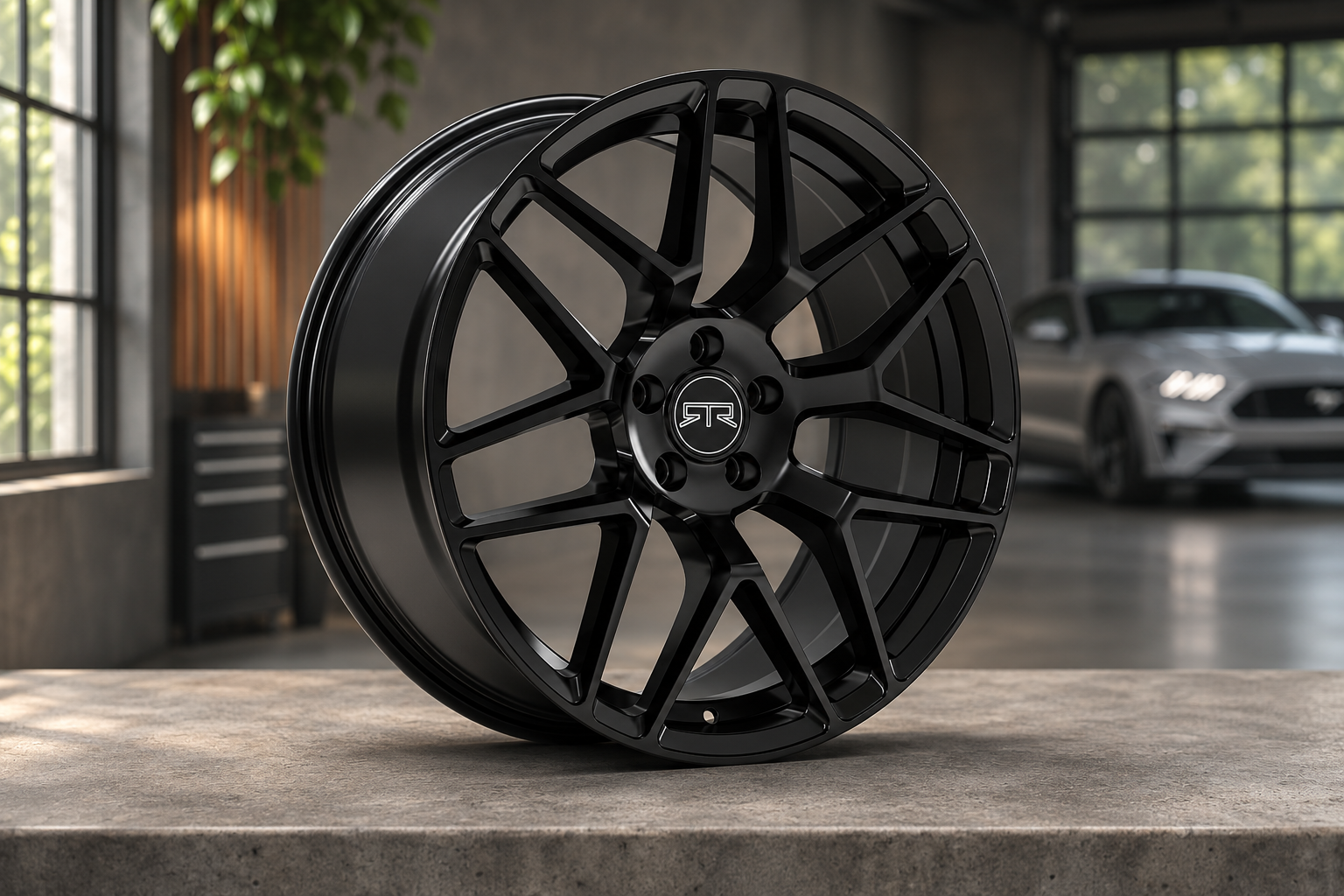
Cover: AI-created editorial styling illustration by Ultimate Stangs, based on the promoted RTR Tech 7 wheel. The background car does not establish wheel installation or fitment.
The right Mustang wheels start with your car’s hubs, brakes and intended use, then the style you want. A classic styled wheel, a rounded five-spoke and a modern split-spoke can each suit a Mustang beautifully. Their diameters, widths and offsets solve different fitment problems, however. Choose the complete combination before ordering four rims that merely share a bolt pattern.
This guide compares six pictured wheel options, from four-lug classic applications to selected S650 GT fitments. It also explains where Fox Body owners need a separate search, how square and staggered sets differ, and which hardware belongs in the budget. For rubber compounds and seasonal choices, use our Mustang tire buying guide.
Affiliate disclosure: Ultimate Stangs may earn a commission through shopping links at no extra cost to you. Our selection is based on supplier applications and documented specifications; we have not independently tested these wheels for strength, weight or lap times.
Start with your Mustang’s generation
Record the model year, trim, brake package, suspension changes and the wheels currently fitted. On a used Mustang, ask about axle, hub and spindle conversions. Those changes can make the hardware on the car more important than the badge or year on its registration. Have the seller confirm the exact wheel SKU against that specification.
| Mustang years | Where to start | What needs checking |
|---|---|---|
| 1964½–1973 classic | Identify four- or five-lug hubs | Exact year, brakes, backspacing and fender clearance |
| 1974–1978 Mustang II | Use a Mustang II-specific listing | Do not assume a classic or Fox wheel fits |
| 1979–1993 Fox Body | Identify original four-lug or converted hubs | Installed brakes, axle width and wheel-specific restrictions |
| 1994–2004 SN95 / New Edge | Find the exact 1994–2004 application | Offset, front/rear position and brake clearance |
| 2005–2014 S197 | Check trim and brake package | Lug-seat hardware, steering clearance and ride height |
| 2015–2023 S550 | Check GT, EcoBoost or special-model application | Caliper/spoke clearance and front/rear wheel sizes |
| 2024–2026 S650 | Require a listing for the exact year and trim | Brake package, sensors and any rear-only designation |
Four-lug does not describe a single interchangeable Mustang wheel. The classic GT8 shown below has a 4 × 4.5-inch pattern; it is not a substitute for a Fox Body wheel. Likewise, a five-lug conversion changes the shopping problem. Confirm the completed conversion’s dimensions before copying another owner’s setup. CJ’s Mustang bolt-pattern reference.
Six Mustang wheel styles to compare
These are individual, specified examples rather than a universal ranking. Each pictured offer opens the selected single-wheel variant. Check whether the seller’s current selector is set to a single wheel, a set or a wheel-and-tire package before comparing totals. A rear-only wheel is not a four-corner recommendation.
Classic four-lug: Legendary GT8
The silver GT8 provides a different route for a classic that still uses its four-lug hubs. The featured 15 × 7 wheel uses a machined lip and a restrained face that suits a period-looking build. Its +7 mm offset and 4.25-inch backspacing belong to this particular wheel. CJ notes extended-thread lug nuts or extended studs, and possible fitment modifications. Include those requirements in the quote rather than treating the wheel’s diameter as the whole specification.
This is a useful starting point for an owner who wants a period-looking wheel while retaining a documented classic four-lug arrangement. It also keeps the shopping decision focused: find the right tire and hardware for the existing hubs before committing to an axle or brake conversion simply to obtain a different wheel style.
The caution is that a compatible bolt pattern does not guarantee clearance. Have the installer check the wheel and tire against the steering, brakes and body through their operating range. A narrow classic wheel opening and a modified suspension can change the result. Compare the complete installed price, including any required studs or extended-thread nuts, with the cost of a more extensive conversion.
Classic five-lug: Styled Alloy
The 16 × 8 Legendary Styled Alloy keeps the recognizable early Mustang wheel theme while giving it a deeper, machined aluminum presentation. It uses five mounting holes and 4.5-inch backspacing. CJ specifically flags modifications for the stated 1965–1966 combination and calls for checking clearance on classic cars. A listed year range is a starting point for measuring your car, especially if it has replacement brakes or bodywork.
The attraction here is the familiar styled-wheel theme with a larger 16-inch diameter, rather than an overtly modern multi-spoke face. It suits a build where the wheel should complement the original lines instead of becoming the strongest visual feature. The five-lug configuration separates it from the four-lug GT8 even though both are aimed at classic Mustangs.
An eight-inch-wide wheel also makes tire choice and clearance part of the decision. Ask the installer to evaluate your actual wheel openings, brakes and ride height, especially on a 1965–1966 car with the seller’s modification warning. Do not treat a supplier photo of several wheels as proof that four are included: the linked selection is one wheel, and the complete set and hardware must be budgeted accordingly.
SN95 and New Edge: Torq Thrust M
American Racing’s black 18 × 9 Torq Thrust M offers a rounded five-spoke alternative to the sharper modern designs. The machined lip is a visible part of its character, so consider how that bright edge works with the car’s trim. This selected wheel is listed for 1994–2004 Mustangs, with +24 mm offset and 6-inch backspacing. It can be considered for either axle within the documented application; clearance still needs confirmation for your brakes and tire.
Its rounded five spokes give an SN95 or New Edge a muscle-car reference without copying the finer mesh patterns of newer designs. The dark center and bright lip create two distinct visual elements; owners who like visible wheel detailing may prefer that contrast to an all-black face. That is a styling judgment, not evidence of superior strength or lower weight.
For a street car, decide on the tire before treating 18 inches as the final answer. Check the tire maker’s approved rim-width range, your desired overall diameter, and the clearance of the installed brake package. If you want the same wheel at all four corners for a square setup, have the supplier confirm both axle applications and hardware. A listed model-year range does not resolve changes made by a previous owner.
S197 and S550: Bronze Velgen VF9
A bronze finish can change the visual balance of a Mustang without matching every exterior accent to black. The featured flow-formed VF9 is 20 × 9.5, with +32 mm offset and a 73.1 mm bore supplied with hub-centric rings. Its listed GT applications stop at 2023. The seller calls for tuner-style lug nuts and excludes certain Shelby models. Treat the included rings, separate lug nuts and required tire sizes as parts of the same purchase.
The finish is its clearest differentiator in this group. Bronze creates a warmer contrast against black, gray or white bodywork, while the detailed face gives the eye more to follow than the Torq Thrust’s broad spokes. The flow-formed construction is a documented design detail; we have no independently measured wheel weight or strength comparison to turn it into a quantified performance claim.
A 20-inch choice should be priced with the intended tire, mounting, balancing, sensors and correct nuts. Whether it gives you the sidewall and everyday road tolerance you want depends on the complete tire specification, not the wheel diameter alone. Check how the supplied hub-centric rings apply to your hubs, and ask for brake clearance confirmation. The listed Shelby exclusions matter even when another Mustang shares the general generation.
A 19-inch alternative: RTR Tech 7
The gloss-black 19 × 9.5 Tech 7 is worth comparing when you prefer a split-spoke face to a larger 20-inch wheel. The chosen version is +33 mm with 6.55-inch backspacing. Its supplier application includes GT models through 2024; this particular listing does not establish 2025–2026 fitment. Center caps are supplied, while the specified tuner-style nuts and TPMS sensors are separate. Do not carry a Tech Mesh application over to a different RTR design.
Compared with the 20-inch VF9 and Tech Mesh examples, this offers a different diameter and spoke treatment within the same broad modern-Mustang shopping task. Gloss black can create a more understated face, although it may show less spoke detail from a distance. Compare photographs on your own car’s body color instead of assuming the same finish looks identical on every build.
The 19 × 9.5 dimensions do not by themselves establish a square fitment, tire size or caliper clearance. Ask for a complete proposal for your trim, brakes and suspension, including the nuts and sensors that are separate from the supplied cap. For a 2025 or 2026 car, obtain explicit confirmation for this exact Tech 7 variant; the longer application range of a different RTR design cannot be transferred to it.
A wider rear: RTR Tech Mesh
The 20 × 10.5 Tech Mesh shown here is explicitly a rear-fitment wheel, with +45 mm offset. CJ lists selected GT and EcoBoost applications through 2026 and excludes the later Shelby applications named on its page. It can form part of a staggered plan, but the matching front wheel is a separate choice. Ask for a complete front/rear proposal that checks caliper clearance, tire sizes and the effect of any lowering before ordering.
This choice starts with a different question: do you actually want a staggered setup? A wider rear wheel can deliver the rear-biased appearance an owner wants, but it also requires an intentional front-wheel and tire pairing. Different front and rear sizes can limit ordinary front-to-rear tire rotation, so discuss the maintenance implications as part of the purchase.
The mesh face gives a more intricate appearance than the Tech 7, but its rear-only designation is the deciding fitment detail. Do not order four of this SKU as a square set. Have the installer check the chosen rear tire, inner and outer clearance, brakes and any lowered suspension. Compare the cost of the two rear wheels together with the correct fronts, mounting hardware and sensors; the single-wheel price is not the cost of the finished staggered package.
Diameter is only one fitment dimension
Offset measures where the mounting face sits relative to the wheel’s centerline. Backspacing measures from the mounting face to the inner edge. Width affects both the space used inside the arch and how the outside edge sits. Two wheels with the same diameter and bolt pattern can therefore occupy quite different positions. For a technical explanation, see CJ’s offset and backspacing guide.
Brake clearance adds another dimension: the spoke shape must clear the caliper, not just the wheel barrel around the rotor. Ask the wheel manufacturer for an application confirmation or a brake template for your exact package. An attractive photo of a GT with similar wheels cannot establish clearance for different brakes. Center-bore compatibility, the correct lug seat, stud engagement and wheel load rating also belong on the seller’s confirmation.
Larger diameter is a styling choice with a tire consequence. For a given overall tire diameter, a larger rim generally leaves less sidewall. Compare the available tire sizes and installed prices before choosing a wheel, especially for rough roads or a car driven every day. A smaller diameter still needs to clear the brakes; it is not automatically an available alternative.
Square or staggered wheels?
A square setup uses the same wheel and tire dimensions at all four corners. It can simplify replacement and rotation planning, provided the complete vehicle application permits that combination. A staggered setup uses different front and rear sizes, often with a wider rear. That can create the rear stance an owner wants, while requiring two separate fitment decisions.
For a daily driver, consider maintenance as well as the parked appearance. Different front/rear sizes restrict front-to-rear rotation, and buying a replacement pair may be more involved. For track use, work from the event, tire and vehicle requirements rather than assuming that a wider rear always makes the car more capable. No lap-time or grip improvement is claimed for the pictured choices.
Watch an S550 fitment walkthrough
CJ Pony Parts explains S550 wheel sizing and fitment in this archival overview. Use it to understand the measurements; current wheel applications and your car’s equipment still control the purchase. The video is not a fitment approval for classic, Fox Body or S650 Mustangs.
Video: CJ Pony Parts.
Budget for the finished installation
Compare quotes for the same deliverables: four wheels, suitable tires, mounting and balancing, required lug nuts or locks, valves and compatible pressure sensors where fitted. Ask whether the seller supplies sensors, whether they require activation, and which original hardware can actually be reused. Shipping and professional fitment checks can change the value of an apparent bargain.
Inspect used wheels for damage and have a competent specialist assess them before committing to tires. For new wheels, understand the seller’s trial-fit and return rules before mounting. Check steering and suspension clearance using the installer’s proper procedure. A photograph at parked ride height does not show what happens at full steering lock or through suspension travel.
Choose care products for the actual finish. A dedicated soft wheel brush can help reach behind spokes, while an iron remover is optional and must be compatible with the coating. Do not assume a cleaner suitable for one painted wheel is safe on polished or damaged finishes. Our wheel-cleaning guide compares appropriate care tools and products. See the pressure and TPMS guide when setting up the finished car.
Mustang wheel buying questions
Will any five-lug wheel fit a Mustang?
No. Match the bolt pattern, width, offset, center bore, brake clearance, load rating and hardware to the exact vehicle. A five-lug count alone is insufficient.
Can I put classic four-lug wheels on a Fox Body?
Do not assume so. The classic GT8 featured here uses a different pattern from a typical original four-lug Fox application. A converted car needs its installed hub, axle and brake specification checked separately.
Are 20-inch wheels better than 19-inch wheels?
Choose by appearance, brake clearance, tire availability, road use and the complete installed cost. Diameter alone does not establish ride quality, strength or handling performance.
Do the pictured wheels include tires and sensors?
The featured links select individual wheels. Package selectors may offer separate sets or tire bundles. Confirm the exact contents, front/rear quantities, lug nuts and TPMS before ordering.
Sources and selection method
Applications and affiliate listings checked November 19, 2026. Supplier photographs show the selected wheel designs; tires and separately sold hardware are not included unless the chosen package says so. Product application pages are linked from each recommendation. Technical references: bolt patterns, offset and backspacing, and CJ’s S550 video. Ultimate Stangs has not performed an independent wheel test.

