


The last stubborn patch of brake dust can make a stronger cleaner look tempting. On a Mustang, though, the finish matters more than how dirty the wheel looks. A clear-coated factory wheel, a refinished aftermarket wheel, and a polished surface may need different products—even when they look similar in a photo.
Quick answer: Identify the wheel finish, let the wheels cool, and use only cleaning products and tools permitted by the wheel manufacturer. Work one wheel at a time, rinse as directed, and dry with a clean, soft towel. Stop before escalating to an aggressive chemical on an unknown finish.
Advertising disclosure: Display advertisements contain affiliate links. Ultimate Stangs may earn a commission if you purchase through them. Advertisements are separate from the maintenance recommendations below.
Identify the finish before choosing the cleaner
Look for the wheel maker’s care instructions, part number, invoice, or refinishing record. The appearance alone cannot tell you whether a shiny area is bare metal, plating, or a clear-coated machined face. A previous owner may also have changed the finish. Ask the supplier or refinisher if the documentation is incomplete.
Record the answer and the approved product type. Keep that note with the wheel information rather than relying on the cleaner’s front label. “For wheels” and “safe for aluminum” are broad descriptions; they do not establish approval for every coating or mixed-material assembly.
| Wheel or finish situation | Start here | Avoid this assumption |
|---|---|---|
| Factory finish in good condition | Your model’s manual and the wheel’s care instructions. | Every factory wheel has the same coating or cleaning limits. |
| Clear-coated painted or machined face | Confirm a coating-compatible cleaner and soft tools. | An exposed-looking machined face is necessarily bare metal. |
| Polished or chrome appearance | Identify the actual surface and manufacturer’s care method. | Metal polish is appropriate because the wheel looks shiny. |
| Refinished, matte, coated, or specialty wheel | Use the refinisher or maker’s specific instructions. | A generic gloss-restoring treatment will preserve the intended finish. |
| Peeling, cracked, or unknown finish | Get the condition identified before aggressive cleaning. | A stronger cleaner will fix damage or make an unknown surface safe. |
Set up a wheel-only cleaning kit
Keep wheel towels and tools separate from paint-washing supplies. Labeling a small container helps prevent a brake-dust-covered cloth from returning to the hood later. Choose tools that reach the areas you actually need without forcing a brush into a narrow gap or dragging its hard handle against a spoke.
Gather the approved cleaner, clean water, suitable soft tools, and drying towels before beginning. Read dilution, contact time, personal-protection, and rinse directions on the current label. If a label warns against a finish on your wheel, do not try to solve the conflict with a shorter dwell time.
A wheel wash you can repeat
Cool and identify
Know the finish. Wait until the wheel is cool.
Rinse loose dirt
Use the permitted rinse method before contact.
Clean one wheel
Use compatible chemistry and soft, dedicated tools.
Rinse and inspect
Remove residue, dry, and look for remaining soil or damage.
How to clean Mustang wheels, step by step
1. Let the wheels cool and check their condition
Park safely and allow the wheels to cool. Ford’s 2026 Mustang wheel-care instructions caution against applying cleaning chemicals to hot wheels. Inspect first: peeling coating, a suspect crack, or a persistent tire-pressure problem calls for an appropriate inspection, not just detailing.
2. Remove loose dirt using the permitted rinse method
Start gently so contact tools do not immediately grind loose grit across the surface. Follow any restrictions for the wheel, finish, or surrounding components. Do not take a pressure or nozzle setting from a body-washing demonstration and assume it covers every wheel assembly.
3. Clean one wheel without letting product dry
Apply the approved product according to its label, including any test-area instruction. Work manageable sections and keep track of the dwell time. A soft tool that fits the spoke opening is more useful than vigorous scrubbing with an oversized brush. Keep the tool’s hard parts away from the finish.
The Wheel Pros care guide recommends cool wheels, gentle cleaning, and soft tools, and warns that even some wheel-specific cleaners can be unsuitable. Those instructions apply to its products; use the requirements for your own wheel if they differ. BBS likewise publishes material-specific care precautions, reinforcing why one universal chemical recommendation is a poor shortcut.
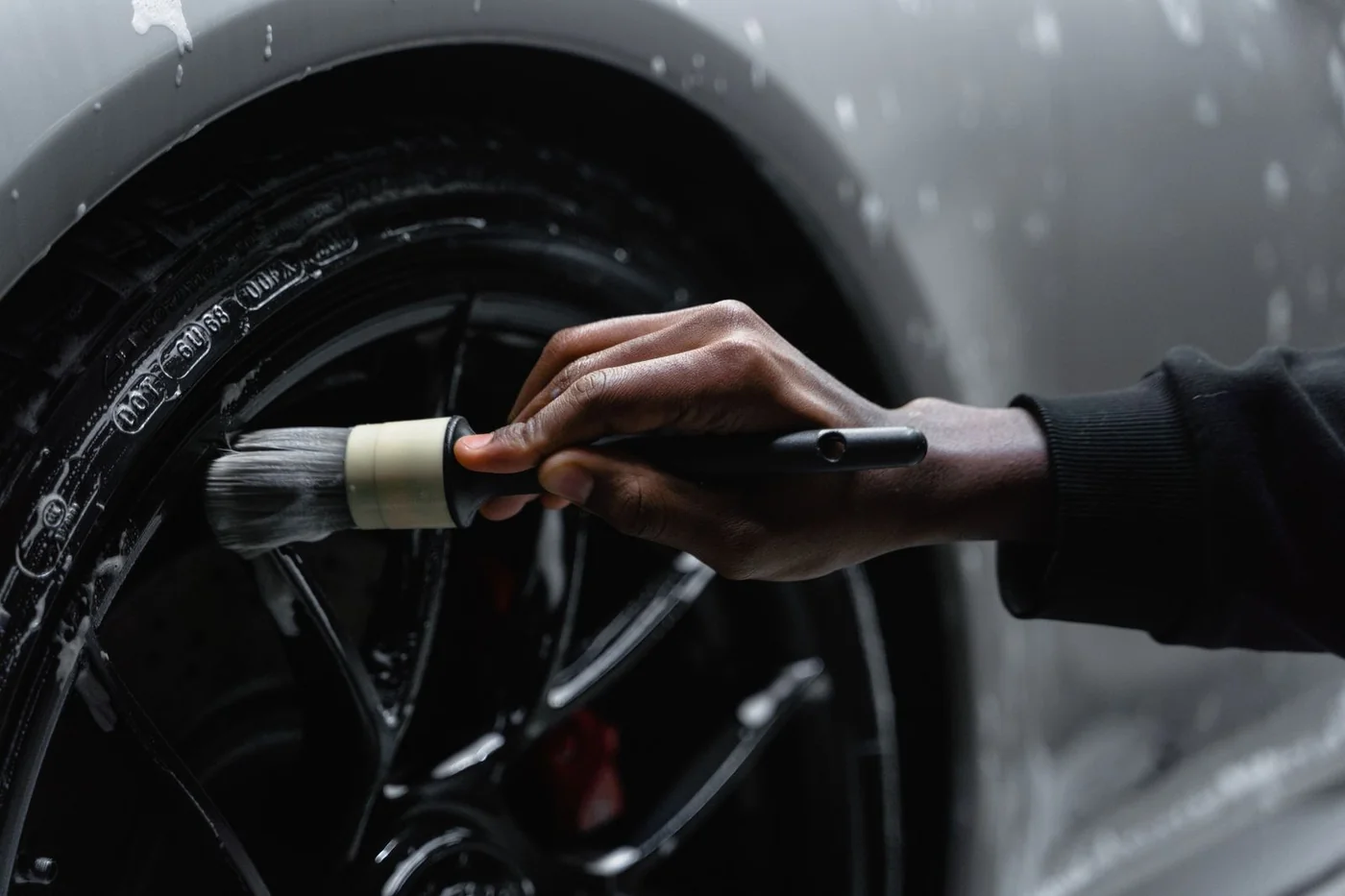
4. Rinse, dry, and decide whether the remainder is dirt
Rinse completely using the method specified by the product and wheel maker. Check recesses where residue can remain, then dry with an appropriate clean, soft towel. Inspect again in good light. A stained or pitted area is not necessarily removable brake dust; repeatedly applying stronger chemistry can make an uncertain situation worse.
Brake dust, staining, or a damaged finish?
Use a simple stopping rule: if the permitted routine has not removed an area, identify it before changing the chemistry. Photograph the clean, dry wheel, note the product and method used, and ask the manufacturer or a qualified refinisher. That record gives them a much clearer starting point than “nothing works.”
Do not sand, polish, or scrub through a protective coating to make the wheel look uniform. Do not work on a suspected crack as a cosmetic problem. A car that needs tire or wheel inspection should be assessed before the next drive, especially if a pressure loss or vibration accompanies what you can see.
Wheel-care products: choose the job before the bottle
You do not need every product for every wash. Start with compatible routine cleaner and a soft wheel-only brush. Consider an iron remover only for remaining ferrous contamination and only if your wheel manufacturer allows it. These are specification-based suggestions, not hands-on test winners.
Keep tire care and wheel care separate
The tire sidewall and wheel finish are different surfaces. A product permitted on one may not be permitted on the other. Follow the label’s restrictions and keep slippery treatments off tire tread and braking surfaces. Cleaner overspray should never become a reason to ignore the surrounding components.
If you are shopping for a different tire setup, read our Mustang tire buying guide. Cleaning a wheel does not confirm tire fitment, load suitability, or the correct pressure. Those require the appropriate vehicle and product specifications.
Finish the wash without undoing it
After wheel care, change to clean body-washing tools. Our Mustang washing and maintenance guide and foam gun versus foam cannon comparison cover the broader routine. A body shampoo discussed there is not automatically a verified wheel-cleaner recommendation.
Before parking for a long period, follow your model’s post-wash instructions and the winter storage checklist. Include a final dry inspection in your notes. The goal is a repeatable method that preserves the finish, not a product collection that grows every time brake dust returns.
Mustang wheel-cleaning FAQs
Can I use the same brush on wheels and paint?
Keep dedicated wheel tools separate from paint tools. A clean-looking brush can still carry contamination from earlier use; separating the kits is a simple way to avoid that mix-up.
Is every acid-free wheel cleaner safe for my finish?
No. An excluded ingredient does not prove complete compatibility. Check the wheel maker’s requirements and the cleaner’s actual finish restrictions.
Can I use metal polish on a shiny wheel?
Only when the manufacturer’s instructions for the identified surface permit it. Shine does not tell you whether a protective coating is present.
What should I buy before washing the wheels?
Start with the instructions for the identified finish, then choose a compatible cleaner and soft, dedicated tools. Keep clean water and drying towels ready before beginning.
The finish comes first
Identify, cool, clean gently, and inspect. If the surface or a stubborn mark remains uncertain, pause and get an answer before increasing the aggressiveness of the method. That is a better long-term routine than judging a cleaner by how dramatic the first application looks.
Sources and image credits
Researched November 12, 2026 using Ford’s 2026 Mustang owner’s manual, wheel-care section, Wheel Pros care guidance, and the BBS instruction manual. This is a source-based maintenance guide, not a hands-on cleaner test or a rating of a wheel product. Consult the instructions for the actual wheel and finish.
Featured photo: Sachith Ravishka Kodikara / Pexels. Pexels-licensed illustrative photography; no endorsement implied.

